Ch. 3 - Derivatives
Hass - Thomas' Calculus 15th Edition
Hass15th EditionThomas' CalculusISBN: 9780137616077Not the one you use?Change textbook
Chapter 3, Problem 3.110

____
Find the linearization of ƒ(x) = 2/ (1 - x) + √1 + x - 3.1 at x = 0.

Verified step by step guidance
1
Identify the function to be linearized: \( f(x) = \frac{2}{1-x} + \sqrt{1+x} - 3.1 \).
Recall the formula for the linearization of a function at a point \( a \): \( L(x) = f(a) + f'(a)(x-a) \). Here, \( a = 0 \).
Calculate \( f(0) \) by substituting \( x = 0 \) into the function: \( f(0) = \frac{2}{1-0} + \sqrt{1+0} - 3.1 \).
Find the derivative \( f'(x) \). Use the sum rule and differentiate each term separately: \( f'(x) = \frac{d}{dx}\left(\frac{2}{1-x}\right) + \frac{d}{dx}(\sqrt{1+x}) \).
Evaluate \( f'(0) \) by substituting \( x = 0 \) into the derivative. Then, use the linearization formula to find \( L(x) = f(0) + f'(0)(x-0) \).

Verified video answer for a similar problem:

This video solution was recommended by our tutors as helpful for the problem above.
Video duration:
5m
Was this helpful?

Key Concepts

Here are the essential concepts you must grasp in order to answer the question correctly.

Linearization

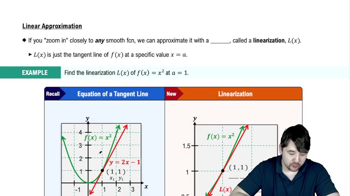
Linearization is the process of approximating a function near a specific point using its tangent line. This involves finding the function's value and its derivative at that point. The linearization formula is given by L(x) = f(a) + f'(a)(x - a), where 'a' is the point of tangency. This technique is useful for simplifying complex functions for easier analysis.
Recommended video:
07:17
Linearization

Derivative

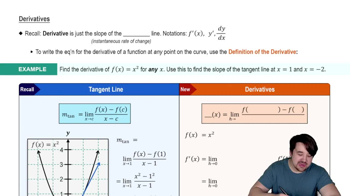
The derivative of a function measures the rate at which the function's value changes as its input changes. It is defined as the limit of the average rate of change of the function over an interval as the interval approaches zero. In the context of linearization, the derivative at a point provides the slope of the tangent line, which is essential for constructing the linear approximation.
Recommended video:
05:44
Derivatives

Function Evaluation

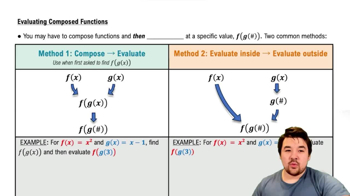
Function evaluation involves calculating the output of a function for a given input. In this case, we need to evaluate the function ƒ(x) at x = 0 to find the point of tangency for linearization. This step is crucial as it provides the y-coordinate of the tangent line, which, along with the slope from the derivative, defines the linear approximation of the function.
Recommended video:
4:26
Evaluating Composed Functions