Ch. 3 - Derivatives
Hass - Thomas' Calculus 15th Edition
Hass15th EditionThomas' CalculusISBN: 9780137616077Not the one you use?Change textbook
Chapter 3, Problem 3.6.19

Find the derivatives of the functions in Exercises 19–40.


p = √(3 − t)

Verified step by step guidance
1
Identify the function you need to differentiate: \( p = \sqrt{3 - t} \). This can be rewritten using exponent notation as \( p = (3 - t)^{1/2} \).
Apply the chain rule for differentiation. The chain rule states that if you have a composite function \( f(g(t)) \), then the derivative \( f'(g(t)) \cdot g'(t) \) is used.
Differentiate the outer function \( f(u) = u^{1/2} \) with respect to \( u \). The derivative is \( \frac{1}{2}u^{-1/2} \).
Differentiate the inner function \( g(t) = 3 - t \) with respect to \( t \). The derivative is \( -1 \).
Combine the derivatives using the chain rule: \( \frac{d}{dt} p = \frac{1}{2}(3 - t)^{-1/2} \cdot (-1) \). Simplify the expression to find the derivative of \( p \).

Verified video answer for a similar problem:

This video solution was recommended by our tutors as helpful for the problem above.
Video duration:
3m
Was this helpful?

Key Concepts

Here are the essential concepts you must grasp in order to answer the question correctly.

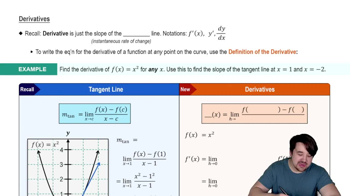
Derivative

The derivative of a function measures how the function's output value changes as its input value changes. It is defined as the limit of the average rate of change of the function over an interval as the interval approaches zero. In practical terms, the derivative provides the slope of the tangent line to the function's graph at any given point.
Recommended video:
05:44
Derivatives

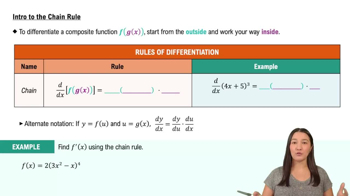
Chain Rule

The chain rule is a fundamental technique in calculus used to differentiate composite functions. It states that if a function y is composed of two functions u and t, then the derivative of y with respect to t can be found by multiplying the derivative of y with respect to u by the derivative of u with respect to t. This rule is essential for functions that are nested within one another.
Recommended video:
05:02
Intro to the Chain Rule

Square Root Function

The square root function, denoted as √x, is a function that returns the non-negative value whose square is x. When differentiating functions involving square roots, it is important to apply the chain rule correctly, as the square root can be expressed as a power of one-half. Understanding the properties of square roots is crucial for accurately finding derivatives of such functions.
Recommended video:
03:19
Completing the Square to Rewrite the Integrand Example 6