Ch. 3 - Derivatives
Hass - Thomas' Calculus 15th Edition
Hass15th EditionThomas' CalculusISBN: 9780137616077Not the one you use?Change textbook
Chapter 3, Problem 3.3.52

Assume that functions f and g are differentiable with f(2) = 3, f'(2) = −1, g(2) = −4, and g'(2) = 1. Find an equation of the line perpendicular to the line tangent to the graph of F(x) = (f(x) + 3) / (x − g(x)) at x = 2.

Verified step by step guidance
1
First, find the derivative of F(x) = (f(x) + 3) / (x - g(x)) using the quotient rule. The quotient rule states that if you have a function h(x) = u(x) / v(x), then h'(x) = (u'(x)v(x) - u(x)v'(x)) / (v(x))^2.
Apply the quotient rule to F(x). Let u(x) = f(x) + 3 and v(x) = x - g(x). Then, u'(x) = f'(x) and v'(x) = 1 - g'(x). Substitute these into the quotient rule formula to find F'(x).
Evaluate F'(x) at x = 2 using the given values: f(2) = 3, f'(2) = −1, g(2) = −4, and g'(2) = 1. Substitute these values into the expression for F'(x) to find the slope of the tangent line at x = 2.
The slope of the line perpendicular to the tangent line is the negative reciprocal of the slope of the tangent line. Calculate this perpendicular slope using the slope found in the previous step.
Use the point-slope form of a line equation, y - y1 = m(x - x1), where m is the perpendicular slope, and (x1, y1) is the point on the graph at x = 2. Calculate F(2) using the given values to find y1, and then write the equation of the line.

Verified video answer for a similar problem:

This video solution was recommended by our tutors as helpful for the problem above.
Video duration:
7m
Was this helpful?

Key Concepts

Here are the essential concepts you must grasp in order to answer the question correctly.

Differentiation

Differentiation is a fundamental concept in calculus that involves finding the derivative of a function, which represents the rate of change of the function with respect to its variable. The derivative at a specific point gives the slope of the tangent line to the graph of the function at that point. In this question, knowing the derivatives of functions f and g at x = 2 is essential for determining the slope of the tangent line to F(x).
Recommended video:
05:53
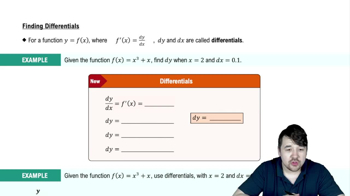
Finding Differentials

Tangent and Perpendicular Lines

A tangent line to a curve at a given point is a straight line that touches the curve at that point without crossing it, and its slope is equal to the derivative of the function at that point. A line is perpendicular to another if the product of their slopes is -1. In this problem, after finding the slope of the tangent line to F(x) at x = 2, the slope of the perpendicular line can be calculated using this relationship.
Recommended video:
05:13
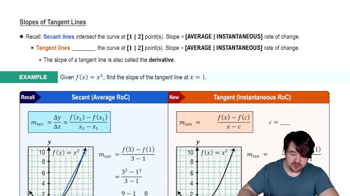
Slopes of Tangent Lines

Function Composition and Quotients

Function composition involves combining two functions where the output of one function becomes the input of another. In this case, F(x) is defined as a quotient of two functions, f(x) and g(x). Understanding how to differentiate a quotient of functions using the quotient rule is crucial for finding the derivative of F(x) and subsequently the slope of the tangent line at x = 2.
Recommended video:
06:43
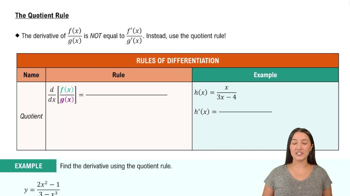
The Quotient Rule