Ch. 3 - Derivatives
Hass - Thomas' Calculus 15th Edition
Hass15th EditionThomas' CalculusISBN: 9780137616077Not the one you use?Change textbook
Chapter 3, Problem 3.17

Find the derivatives of the functions in Exercises 1–42.
______
𝓻 = √2θ sinθ

Verified step by step guidance
1
Identify the function given: \( r = \sqrt{2\theta} \sin\theta \). This is a product of two functions: \( \sqrt{2\theta} \) and \( \sin\theta \).
Apply the product rule for differentiation, which states that if you have a function \( u(\theta) \cdot v(\theta) \), its derivative is \( u'(\theta) \cdot v(\theta) + u(\theta) \cdot v'(\theta) \).
Differentiate \( u(\theta) = \sqrt{2\theta} \). Use the chain rule: \( u'(\theta) = \frac{d}{d\theta}(2\theta)^{1/2} = \frac{1}{2}(2\theta)^{-1/2} \cdot 2 = \frac{1}{\sqrt{2\theta}} \).
Differentiate \( v(\theta) = \sin\theta \). The derivative is \( v'(\theta) = \cos\theta \).
Substitute the derivatives back into the product rule: \( r'(\theta) = \left(\frac{1}{\sqrt{2\theta}}\right) \sin\theta + \sqrt{2\theta} \cos\theta \). Simplify if necessary.

Verified video answer for a similar problem:

This video solution was recommended by our tutors as helpful for the problem above.
Video duration:
3m
Was this helpful?

Key Concepts

Here are the essential concepts you must grasp in order to answer the question correctly.

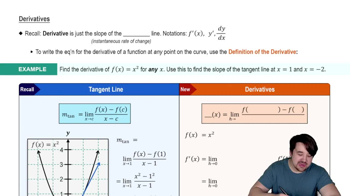
Derivatives

A derivative represents the rate at which a function changes at any given point. It is a fundamental concept in calculus that measures how a function's output value changes as its input value changes. The derivative can be interpreted as the slope of the tangent line to the curve of the function at a specific point.
Recommended video:
05:44
Derivatives

Chain Rule

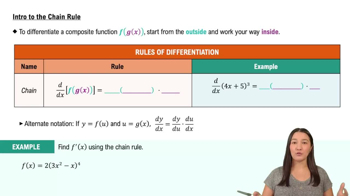
The chain rule is a formula for computing the derivative of a composite function. If a function is composed of two or more functions, the chain rule allows us to differentiate it by multiplying the derivative of the outer function by the derivative of the inner function. This is particularly useful when dealing with functions expressed in terms of other variables, such as polar coordinates.
Recommended video:
05:02
Intro to the Chain Rule

Polar Coordinates

Polar coordinates represent points in a plane using a distance from a reference point and an angle from a reference direction. In this context, the function 𝓻 = √2θ sinθ is expressed in polar form, where 𝓻 is the radius and θ is the angle. Understanding how to differentiate functions in polar coordinates is essential for finding derivatives in this format.
Recommended video:
06:10
Determining Concavity from the Graph of f' or f'' Example 1