Ch. 3 - Derivatives
Hass - Thomas' Calculus 15th Edition
Hass15th EditionThomas' CalculusISBN: 9780137616077Not the one you use?Change textbook
Chapter 3, Problem 3.3.31

Find the derivatives of all orders of the functions in Exercises 29–32.


y = x⁵ / 120

Verified step by step guidance
1
Step 1: Identify the function given, which is \( y = \frac{x^5}{120} \). This is a polynomial function divided by a constant.
Step 2: Recognize that the derivative of a constant multiplied by a function is the constant multiplied by the derivative of the function. Here, the constant is \( \frac{1}{120} \).
Step 3: Apply the power rule for differentiation, which states that the derivative of \( x^n \) is \( nx^{n-1} \). For the first derivative, differentiate \( x^5 \) to get \( 5x^4 \).
Step 4: Multiply the result from Step 3 by the constant \( \frac{1}{120} \) to get the first derivative: \( y' = \frac{5x^4}{120} \).
Step 5: To find higher order derivatives, continue applying the power rule to the result from the previous derivative, reducing the power of \( x \) by 1 each time, until the derivative becomes zero.

Verified video answer for a similar problem:

This video solution was recommended by our tutors as helpful for the problem above.
Video duration:
3m
Was this helpful?

Key Concepts

Here are the essential concepts you must grasp in order to answer the question correctly.

Derivative

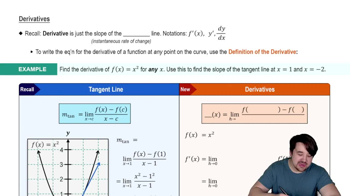
The derivative of a function measures how the function's output value changes as its input value changes. It is defined as the limit of the average rate of change of the function over an interval as the interval approaches zero. In calculus, the derivative is often denoted as f'(x) or dy/dx, and it provides critical information about the function's behavior, such as its slope and concavity.
Recommended video:
05:44
Derivatives

Power Rule

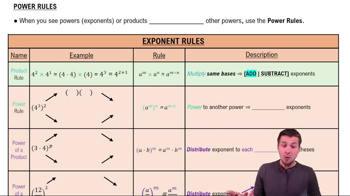
The Power Rule is a fundamental technique for finding the derivative of polynomial functions. It states that if y = x^n, where n is a real number, then the derivative y' = n*x^(n-1). This rule simplifies the differentiation process, especially for functions involving powers of x, allowing for quick computation of derivatives for any order.
Recommended video:

Higher-Order Derivatives

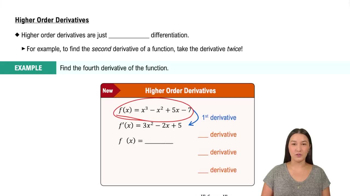
Higher-order derivatives refer to the derivatives of a function taken multiple times. The first derivative gives the rate of change, the second derivative provides information about the curvature or acceleration, and so on. For a function y, the nth derivative is denoted as y^(n) or f^(n)(x), and understanding these derivatives is essential for analyzing the function's behavior in greater detail.
Recommended video:
02:42
Higher Order Derivatives