
Textbook Question
Finding Limits
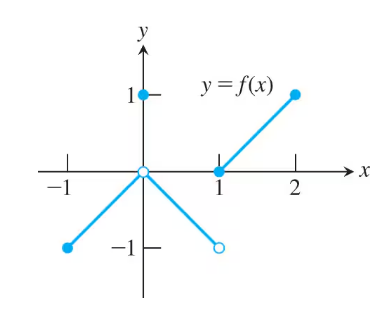
For the function f whose graph is given, determine the following limits. Write ∞ or −∞ where appropriate.
h. lim x → ∞ f(x)
1
views

 Verified step by step guidance
 4:26
4:26
 06:15
06:15 4:46
4:46Finding Limits
For the function f whose graph is given, determine the following limits. Write ∞ or −∞ where appropriate.
h. lim x → ∞ f(x)
Finding Limits Graphically
Which of the following statements about the function y = f(x) graphed here are true, and which are false?
<IMAGE>
k. limx→3+ f(x) does not exist.
Finding Limits Graphically
Which of the following statements about the function y = f(x) graphed here are true, and which are false?
<IMAGE>
g. limx→0+ f(x) = limx→0− f(x)
Finding Limits Graphically
Which of the following statements about the function y = f(x) graphed here are true, and which are false?
e. limx→1+ f(x) = 1
Limits and Continuity
Suppose that ƒ(t) and ƒ(t) are defined for all t and that lim t → t₀ ƒ(t) = ―7 and lim (t → t₀) g (t) = 0 . Find the limit as t → t₀ of the following functions.
e. cos (g(t))
Limits and Continuity
On what intervals are the following functions continuous?
d. k(x) = x⁻¹/⁶