Ch. 2 - Limits and Continuity
Hass - Thomas' Calculus 15th Edition
Hass15th EditionThomas' CalculusISBN: 9780137616077Not the one you use?Change textbook
Chapter 2, Problem 3e

Limits and Continuity


Suppose that ƒ(t) and ƒ(t) are defined for all t and that lim t → t₀ ƒ(t) = ―7 and lim (t → t₀) g (t) = 0 . Find the limit as t → t₀ of the following functions.
e. cos (g(t))

Verified step by step guidance
1
First, recall the limit property for composite functions: if lim(t → t₀) g(t) = L and the function h is continuous at L, then lim(t → t₀) h(g(t)) = h(L).
In this problem, we are given that lim(t → t₀) g(t) = 0. We need to determine if the function cos(x) is continuous at x = 0.
The cosine function, cos(x), is continuous for all real numbers, including at x = 0. Therefore, we can apply the limit property for composite functions.
Using the property, we substitute L = 0 into the continuous function cos(x), giving us lim(t → t₀) cos(g(t)) = cos(0).
Finally, evaluate cos(0) to find the limit. Remember, cos(0) is a well-known trigonometric value.

Verified video answer for a similar problem:

This video solution was recommended by our tutors as helpful for the problem above.
Video duration:
1m
Was this helpful?

Key Concepts

Here are the essential concepts you must grasp in order to answer the question correctly.

Limits

A limit describes the value that a function approaches as the input approaches a certain point. In this context, we are interested in the behavior of the functions ƒ(t) and g(t) as t approaches t₀. Understanding limits is crucial for evaluating the continuity and behavior of functions at specific points.
Recommended video:
05:50
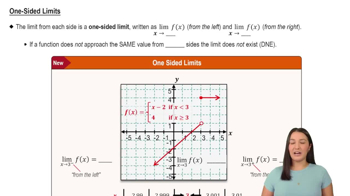
One-Sided Limits

Continuity

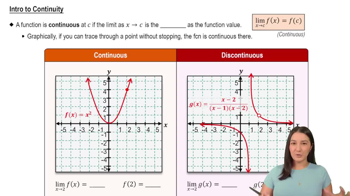
A function is continuous at a point if the limit of the function as it approaches that point equals the function's value at that point. In this case, since lim t → t₀ ƒ(t) = -7, it suggests that ƒ(t) is continuous at t₀ if ƒ(t₀) = -7. Continuity is essential for ensuring that limits can be evaluated without abrupt changes in function values.
Recommended video:
05:34
Intro to Continuity

Composition of Functions

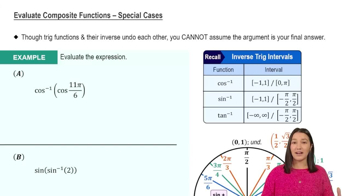
The composition of functions involves applying one function to the result of another. In this problem, we need to evaluate cos(g(t)) as t approaches t₀. Since we know the limit of g(t) as t approaches t₀ is 0, we can find the limit of the composition by substituting this limit into the outer function, cos(x), to determine the overall limit.
Recommended video:
3:48
Evaluate Composite Functions - Special Cases