Ch. 2 - Limits and Continuity
Hass - Thomas' Calculus 15th Edition
Hass15th EditionThomas' CalculusISBN: 9780137616077Not the one you use?Change textbook
Chapter 2, Problem 2.4.46

Using limθ→0 sin θ / θ = 1


Find the limits in Exercises 23–46.


limx→0 (cos²x − cos x) / x²

Verified step by step guidance
1
First, recognize that the limit involves a trigonometric function and a polynomial expression. We need to simplify the expression (cos²x − cos x) / x² as x approaches 0.
Use the trigonometric identity: cos²x = 1 - sin²x. Substitute this into the expression to get: ((1 - sin²x) - cos x) / x².
Next, apply the Taylor series expansion for cos x around x = 0: cos x ≈ 1 - x²/2. Substitute this approximation into the expression.
Simplify the expression using the Taylor expansion: ((1 - sin²x) - (1 - x²/2)) / x². This simplifies to: (sin²x - x²/2) / x².
Finally, evaluate the limit as x approaches 0. Consider the behavior of sin²x/x² as x approaches 0, using the fact that limθ→0 sin θ / θ = 1, and simplify the expression further to find the limit.

Verified video answer for a similar problem:

This video solution was recommended by our tutors as helpful for the problem above.
Video duration:
5m
Was this helpful?

Key Concepts

Here are the essential concepts you must grasp in order to answer the question correctly.

Limit of a Function

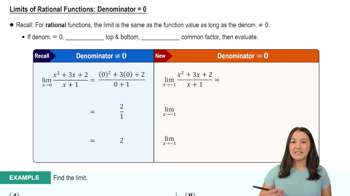
The limit of a function describes the behavior of the function as the input approaches a particular value. In calculus, understanding limits is crucial for analyzing the continuity and differentiability of functions. For the given problem, evaluating the limit as x approaches 0 is essential to determine the behavior of the expression (cos²x − cos x) / x².
Recommended video:
06:11
Limits of Rational Functions: Denominator = 0

L'Hôpital's Rule

L'Hôpital's Rule is a method for finding limits of indeterminate forms, such as 0/0 or ∞/∞. It states that if the limit of f(x)/g(x) as x approaches a value results in an indeterminate form, the limit can be found by differentiating the numerator and denominator separately. This rule is particularly useful for the given problem, where direct substitution leads to an indeterminate form.
Recommended video:

Trigonometric Limits

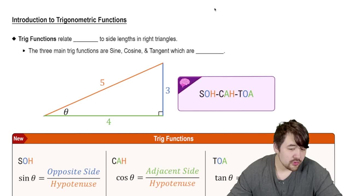
Trigonometric limits involve the behavior of trigonometric functions as the input approaches a specific value. A fundamental trigonometric limit is limθ→0 sin θ / θ = 1, which is often used to evaluate limits involving sine and cosine functions. Understanding this concept helps in simplifying expressions and finding limits involving trigonometric functions, as seen in the given problem.
Recommended video:
6:04
Introduction to Trigonometric Functions