Ch. 2 - Limits and Continuity
Hass - Thomas' Calculus 15th Edition
Hass15th EditionThomas' CalculusISBN: 9780137616077Not the one you use?Change textbook
Chapter 2, Problem 2.5.44

Define g(4) in a way that extends g(x) = (x² − 16)/(x² − 3x − 4) to be continuous at x = 4.

Verified step by step guidance
1
First, identify the points where the function g(x) = (x² − 16)/(x² − 3x − 4) is undefined. This occurs when the denominator is zero. Set x² − 3x − 4 = 0 and solve for x.
Factor the quadratic equation x² − 3x − 4 = 0. This can be factored as (x - 4)(x + 1) = 0, giving the solutions x = 4 and x = -1. These are the points where the function is undefined.
To make g(x) continuous at x = 4, we need to remove the discontinuity by simplifying the expression. Notice that the numerator x² − 16 can be factored as (x - 4)(x + 4).
Simplify the expression by canceling the common factor (x - 4) from the numerator and the denominator. This gives us a new function h(x) = (x + 4)/(x + 1) for x ≠ 4.
Finally, define g(4) as the limit of h(x) as x approaches 4. Calculate this limit by substituting x = 4 into h(x), resulting in g(4) = (4 + 4)/(4 + 1).

Verified video answer for a similar problem:

This video solution was recommended by our tutors as helpful for the problem above.
Video duration:
2m
Was this helpful?

Key Concepts

Here are the essential concepts you must grasp in order to answer the question correctly.

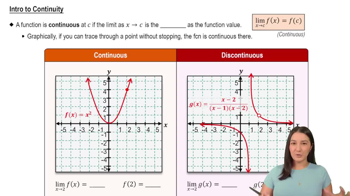
Continuity of Functions

A function is continuous at a point if the limit of the function as it approaches that point equals the function's value at that point. For a function to be continuous at x = 4, we need to ensure that the limit of g(x) as x approaches 4 exists and is equal to g(4). This is crucial for defining g(4) in a way that maintains continuity.
Recommended video:
05:34
Intro to Continuity

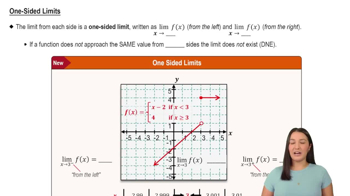
Limits

The limit of a function describes the behavior of the function as it approaches a specific input value. In this case, we need to calculate the limit of g(x) as x approaches 4. If this limit exists, it can be used to define g(4) such that the function remains continuous at that point.
Recommended video:
05:50
One-Sided Limits

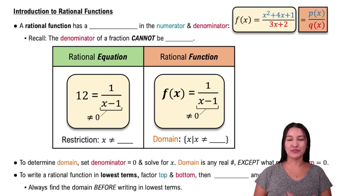
Rational Functions

Rational functions are ratios of polynomials, and they can have points of discontinuity where the denominator equals zero. In the given function g(x) = (x² − 16)/(x² − 3x − 4), we need to analyze the denominator to identify any discontinuities at x = 4 and determine how to redefine g(4) to eliminate this discontinuity.
Recommended video:
6:04
Intro to Rational Functions