
Ch. 2 - Limits and Continuity
Hass - Thomas' Calculus 15th Edition
Hass15th EditionThomas' CalculusISBN: 9780137616077Not the one you use?Change textbook
Chapter 2, Problem 2.4.47

Theory and Examples


Once you know limx→a+ f(x) and limx→a− f(x) at an interior point of the domain of f, do you then know limx→a f(x)? Give reasons for your answer.

Verified step by step guidance
1
To determine \( \lim_{x \to a} f(x) \), we need to consider both the right-hand limit \( \lim_{x \to a^+} f(x) \) and the left-hand limit \( \lim_{x \to a^-} f(x) \).
The limit \( \lim_{x \to a} f(x) \) exists if and only if both the right-hand limit and the left-hand limit exist and are equal.
If \( \lim_{x \to a^+} f(x) = L \) and \( \lim_{x \to a^-} f(x) = L \), then \( \lim_{x \to a} f(x) = L \).
If \( \lim_{x \to a^+} f(x) \neq \lim_{x \to a^-} f(x) \), then \( \lim_{x \to a} f(x) \) does not exist.
Therefore, knowing both \( \lim_{x \to a^+} f(x) \) and \( \lim_{x \to a^-} f(x) \) allows us to determine \( \lim_{x \to a} f(x) \) only if they are equal.

Verified video answer for a similar problem:

This video solution was recommended by our tutors as helpful for the problem above.
Video duration:
1m

Key Concepts

Here are the essential concepts you must grasp in order to answer the question correctly.

Limits from the Right and Left

In calculus, the limit of a function as it approaches a point from the right (denoted as limx→a+ f(x)) and from the left (denoted as limx→a− f(x)) are crucial for understanding the behavior of the function near that point. If both one-sided limits exist and are equal, it suggests that the overall limit at that point may also exist.
Recommended video:
Guided course
07:39
Left, Right, & Midpoint Riemann Sums

Existence of a Limit

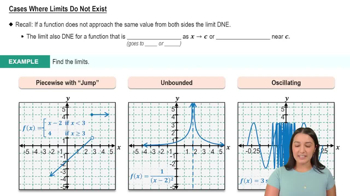
A limit exists at a point if the values of the function approach a specific number as the input approaches that point from both sides. For limx→a f(x) to exist, it is necessary that both limx→a+ f(x) and limx→a− f(x) not only exist but also be equal. If they differ, the overall limit does not exist.
Recommended video:
03:07
Cases Where Limits Do Not Exist

Continuity and Discontinuity

A function is continuous at a point if the limit as it approaches that point equals the function's value at that point. Discontinuities can arise when the one-sided limits are not equal or when either limit does not exist. Understanding these concepts helps in determining the nature of the function at the point in question.
Recommended video:
05:34
Intro to Continuity