
Ch. 2 - Limits and Continuity
Hass - Thomas' Calculus 15th Edition
Hass15th EditionThomas' CalculusISBN: 9780137616077Not the one you use?Change textbook
Chapter 2, Problem 2.1.6

Average Rates of Change


In Exercises 1–6, find the average rate of change of the function over the given interval or intervals.


P(θ)=θ³ − 4θ² + 5θ; [1,2]

Verified step by step guidance
1
Identify the function P(θ) = θ³ − 4θ² + 5θ and the interval [1, 2].
Recall that the average rate of change of a function over an interval [a, b] is given by the formula: (P(b) - P(a)) / (b - a).
Substitute the endpoints of the interval into the function to find P(1) and P(2).
Calculate P(1) by substituting θ = 1 into the function: P(1) = 1³ − 4(1)² + 5(1).
Calculate P(2) by substituting θ = 2 into the function: P(2) = 2³ − 4(2)² + 5(2).

Verified video answer for a similar problem:

This video solution was recommended by our tutors as helpful for the problem above.
Video duration:
2m
Was this helpful?

Key Concepts

Here are the essential concepts you must grasp in order to answer the question correctly.

Average Rate of Change

The average rate of change of a function over an interval [a, b] is defined as the change in the function's value divided by the change in the input value. Mathematically, it is expressed as (f(b) - f(a)) / (b - a). This concept is crucial for understanding how a function behaves over a specific range and is often used to analyze the function's growth or decline.
Recommended video:
06:37
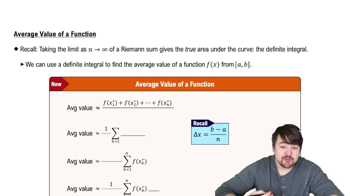
Average Value of a Function

Function Evaluation

Function evaluation involves substituting specific values into a function to determine its output. For the function P(θ) = θ³ − 4θ² + 5θ, evaluating it at the endpoints of the interval [1, 2] means calculating P(1) and P(2). This step is essential for finding the average rate of change, as it provides the necessary values to compute the difference in the function's output.
Recommended video:
4:26
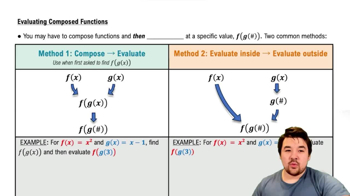
Evaluating Composed Functions

Polynomial Functions

Polynomial functions are mathematical expressions that involve variables raised to whole number powers, combined using addition, subtraction, and multiplication. The function P(θ) = θ³ − 4θ² + 5θ is a cubic polynomial, which can exhibit various behaviors such as increasing, decreasing, and having local maxima or minima. Understanding the properties of polynomial functions helps in analyzing their rates of change and overall behavior.
Recommended video:
6:04
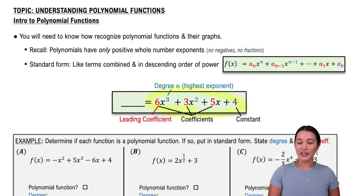
Introduction to Polynomial Functions