
Textbook Question
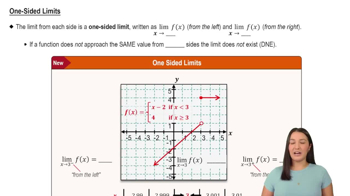
Use the graph of the greatest integer function y = ⌊x⌋, Figure 1.10 in Section 1.1, to help you find the limits in Exercises 21 and 22.
<IMAGE>
b. limt→4−(t−⌊t⌋)

 Verified step by step guidance
 05:50
05:50
 5:50
5:50 05:34
05:34Use the graph of the greatest integer function y = ⌊x⌋, Figure 1.10 in Section 1.1, to help you find the limits in Exercises 21 and 22.
<IMAGE>
b. limt→4−(t−⌊t⌋)
Finding One-Sided Limits Algebraically
Find the limits in Exercises 11–20.
a. limx→0+ (1 − cos x) / |cos x − 1|
[Technology Exercise] Roots
Let ƒ(𝓍) = 𝓍³ ―𝓍― 1.
a. Use the Intermediate Value Theorem to show that ƒ has a zero between ―1 and 2 .
Theory and Examples
If limx→−2 f(x) / x² = 1, find
b. limx→−2 f(x) / x
Find the limits in Exercises 59–62. Write ∞ or −∞ where appropriate.
lim ( 1 / x¹/³ − 1 / (x − 1)⁴/³ ) as
a. x → 0⁺
Average Rates of Change
In Exercises 1–6, find the average rate of change of the function over the given interval or intervals.
g(t)=2+cos t
b. [0,π]