Ch. 2 - Limits and Continuity
Hass - Thomas' Calculus 15th Edition
Hass15th EditionThomas' CalculusISBN: 9780137616077Not the one you use?Change textbook
Chapter 2, Problem 2.6.62a

Find the limits in Exercises 59–62. Write ∞ or −∞ where appropriate.


lim ( 1 / x¹/³ − 1 / (x − 1)⁴/³ ) as


a. x → 0⁺

Verified step by step guidance
1
Identify the individual terms in the expression: \( \frac{1}{x^{1/3}} \) and \( \frac{1}{(x-1)^{4/3}} \).
Consider the behavior of each term as \( x \to 0^+ \). For \( \frac{1}{x^{1/3}} \), as \( x \to 0^+ \), \( x^{1/3} \to 0^+ \), so \( \frac{1}{x^{1/3}} \to +\infty \).
For the term \( \frac{1}{(x-1)^{4/3}} \), as \( x \to 0^+ \), \( x-1 \to -1 \), so \( (x-1)^{4/3} \to 1 \) because the cube root of a negative number raised to the fourth power is positive. Thus, \( \frac{1}{(x-1)^{4/3}} \to 1 \).
Combine the limits of the two terms: \( \lim_{x \to 0^+} \left( \frac{1}{x^{1/3}} - \frac{1}{(x-1)^{4/3}} \right) = \lim_{x \to 0^+} \frac{1}{x^{1/3}} - \lim_{x \to 0^+} \frac{1}{(x-1)^{4/3}} \).
Since \( \frac{1}{x^{1/3}} \to +\infty \) and \( \frac{1}{(x-1)^{4/3}} \to 1 \), the overall limit is \( +\infty - 1 = +\infty \).

Verified video answer for a similar problem:

This video solution was recommended by our tutors as helpful for the problem above.
Video duration:
2m
Was this helpful?

Key Concepts

Here are the essential concepts you must grasp in order to answer the question correctly.

Limit of a Function

The limit of a function describes the behavior of the function as the input approaches a particular value. In this context, we are interested in the limit as x approaches 0 from the positive side (x → 0⁺), which involves understanding how the function behaves near this point and whether it approaches a finite number, infinity, or negative infinity.
Recommended video:
06:11
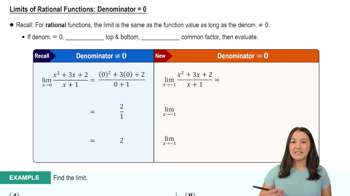
Limits of Rational Functions: Denominator = 0

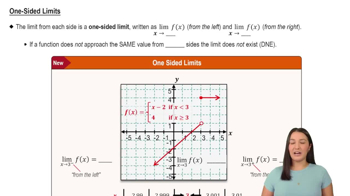
One-Sided Limits

One-sided limits consider the behavior of a function as the input approaches a specific value from one side only, either from the left (x → a⁻) or the right (x → a⁺). In this problem, x → 0⁺ indicates we are examining the limit as x approaches 0 from the positive side, which is crucial for understanding the function's behavior in this specific direction.
Recommended video:
05:50
One-Sided Limits

Indeterminate Forms

Indeterminate forms occur in limits when the expression does not initially provide a clear answer, such as 0/0 or ∞ - ∞. These forms require further analysis or algebraic manipulation to resolve. In this problem, the expression involves terms that may lead to indeterminate forms as x approaches 0, necessitating techniques like simplification or substitution to find the limit.
Recommended video:
Guided course
3:56
Slope-Intercept Form