
Textbook Question
Limits and Continuity
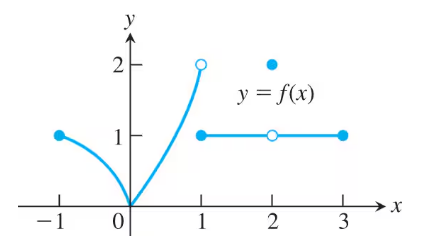
On what intervals are the following functions continuous?
b. g(x) = csc x
1
views

 Verified step by step guidance
 05:50
05:50
 6:47
6:47 03:07
03:07Limits and Continuity
On what intervals are the following functions continuous?
b. g(x) = csc x
Theory and Examples
If limx→−2 f(x) / x² = 1, find
b. limx→−2 f(x) / x
Average Rates of Change
In Exercises 1–6, find the average rate of change of the function over the given interval or intervals.
g(t)=2+cos t
b. [0,π]
Limits and Continuity
On what intervals are the following functions continuous?
b. g(x) = x³/⁴
Estimating Limits
[Technology Exercise] You will find a graphing calculator useful for Exercises 67–74.
Let f(x) = (x² - 9) / (x + 3)
b. Support your conclusions in part (a) by graphing f near c = -3 and using Zoom and Trace to estimate y-values on the graph as x → −3.
Estimating Limits
[Technology Exercise] You will find a graphing calculator useful for Exercises 67–74.
Let G(x)=(x + 6)/(x² + 4x − 12)
b. Support your conclusions in part (a) by graphing G and using Zoom and Trace to estimate y-values on the graph as x→−6.