Ch. 2 - Limits and Continuity
Hass - Thomas' Calculus 15th Edition
Hass15th EditionThomas' CalculusISBN: 9780137616077Not the one you use?Change textbook
Chapter 2, Problem 2.2.60

Limits of Average Rates of Change


Because of their connection with secant lines, tangents, and instantaneous rates, limits of the form limh→0 (f(x+h) − f(x)) / h occur frequently in calculus. In Exercises 57–62, evaluate this limit for the given value of x and function f.


f(x) = 1/x, x = -2

Verified step by step guidance
1
Identify the function f(x) = 1/x and the point x = -2 where we need to evaluate the limit.
Set up the expression for the average rate of change: (f(x+h) - f(x)) / h. Substitute f(x) = 1/x into this expression.
Substitute x = -2 into the expression, resulting in (f(-2+h) - f(-2)) / h.
Calculate f(-2+h) = 1/(-2+h) and f(-2) = 1/(-2). Substitute these into the expression to get: (1/(-2+h) - 1/(-2)) / h.
Simplify the expression: Combine the fractions in the numerator to get a single fraction, and then simplify the entire expression. Finally, take the limit as h approaches 0.

Verified video answer for a similar problem:

This video solution was recommended by our tutors as helpful for the problem above.
Video duration:
4m
Was this helpful?

Key Concepts

Here are the essential concepts you must grasp in order to answer the question correctly.

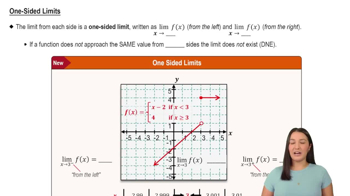
Limits

In calculus, a limit describes the behavior of a function as its input approaches a certain value. It is fundamental for understanding continuity, derivatives, and integrals. The notation lim h→0 (f(x+h) - f(x)) / h specifically represents the limit of the average rate of change of a function as the interval approaches zero, which leads to the concept of the derivative.
Recommended video:
05:50
One-Sided Limits

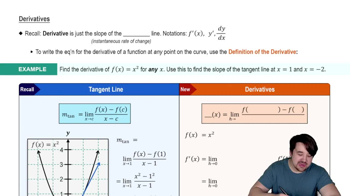
Derivatives

The derivative of a function at a point quantifies the rate at which the function's value changes as its input changes. It is defined as the limit of the average rate of change of the function over an interval as the interval shrinks to zero. Derivatives are essential for analyzing the behavior of functions, including finding slopes of tangent lines and optimizing functions.
Recommended video:
05:44
Derivatives

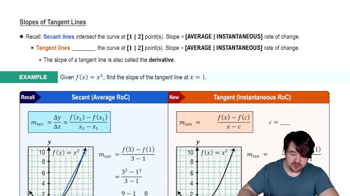
Secant and Tangent Lines

A secant line intersects a curve at two or more points, representing the average rate of change between those points. In contrast, a tangent line touches the curve at a single point and represents the instantaneous rate of change at that point. The transition from secant to tangent lines is crucial in calculus, as it leads to the definition of derivatives and the concept of limits.
Recommended video:
05:13
Slopes of Tangent Lines