
Textbook Question
Intervals of Convergence
In Exercises 1–36, (a) find the series’ radius and interval of convergence.
∑ (from n = 1 to ∞) [ (3x + 1)^(n + 1) / (2n + 2) ]

 Verified step by step guidance
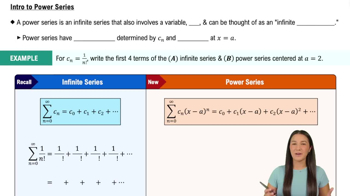
 05:58
05:58
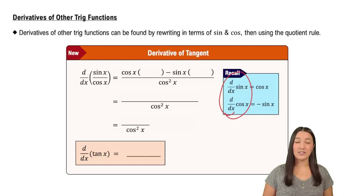 06:30
06:30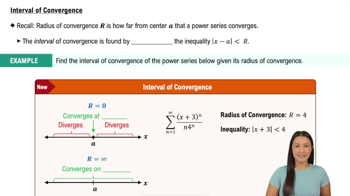 08:44
08:44Intervals of Convergence
In Exercises 1–36, (a) find the series’ radius and interval of convergence.
∑ (from n = 1 to ∞) [ (3x + 1)^(n + 1) / (2n + 2) ]
(Continuation of Exercise 61.) Use the result in Exercise 61 to determine which of the following series converge and which diverge. Support your answer in each case.
a. ∑ (from n=2 to ∞) [1 / (n ln n)]
Power Series
In Exercises 47–56, (a) find the series’ radius and interval of convergence. Then identify the values of x for which the series converges (b) absolutely and (c) conditionally.
∑ (from n = 1 to ∞) xⁿ/nⁿ
Power Series
In Exercises 47–56, (a) find the series’ radius and interval of convergence. Then identify the values of x for which the series converges (b) absolutely and (c) conditionally.
∑ (from n = 1 to ∞) (csch n)xⁿ
Assume that the series ∑ aₙ(x − 2)ⁿ converges for x = −1 and diverges for x = 6. Answer true (T), false (F), or not enough information given (N) for the following statements about the series.
a. Converges absolutely for x = 1
Determining Convergence of Sequences
Which of the sequences whose nth terms appear in Exercises 1–18 converge, and which diverge? Find the limit of each convergent sequence.
aₙ = (-4)ⁿ/n!