
Textbook Question
Intervals of Convergence
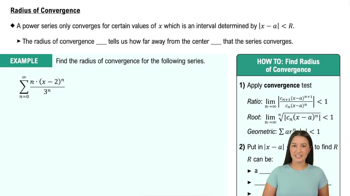
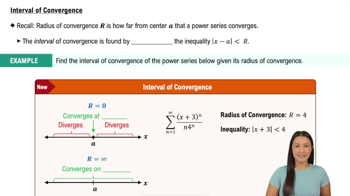
In Exercises 1–36, (a) find the series’ radius and interval of convergence.
∑ (from n = 1 to ∞) [ (3x + 1)^(n + 1) / (2n + 2) ]

 Verified step by step guidance
 07:36
07:36
 08:44
08:44 07:51
07:51Intervals of Convergence
In Exercises 1–36, (a) find the series’ radius and interval of convergence.
∑ (from n = 1 to ∞) [ (3x + 1)^(n + 1) / (2n + 2) ]
Assume that bₙ is a sequence of positive numbers converging to 1/3. Determine if the following series converge or diverge.
a. ∑ (from n = 1 to ∞) [(bₙ₊₁ + bₙ) / n 4ⁿ]
(Continuation of Exercise 61.) Use the result in Exercise 61 to determine which of the following series converge and which diverge. Support your answer in each case.
a. ∑ (from n=2 to ∞) [1 / (n ln n)]
The series
sec x = 1 + x²/2 + 5x⁴/24 + 61x⁶/720 + 277x⁸/8064 + ⋯
converges to sec x for −π/2 < x < π/2.
a. Find the first five terms of a power series for the function ln|sec x + tan x|. For what values of x should the series converge?
Determining Convergence of Sequences
Which of the sequences whose nth terms appear in Exercises 1–18 converge, and which diverge? Find the limit of each convergent sequence.
aₙ = (-4)ⁿ/n!
Intervals of Convergence
In Exercises 1–36, (a) find the series’ radius and interval of convergence.
∑ (from n = 0 to ∞) [ (−2)ⁿ (n + 1) (x − 1)ⁿ ]