Ch. 10 - Infinite Sequences and Series
Hass - Thomas' Calculus 15th Edition
Hass15th EditionThomas' CalculusISBN: 9780137616077Not the one you use?Change textbook
Chapter 10, Problem 10.7.46

In Exercises 43–50, use Theorem 20 to find the series’ interval of convergence and, within this interval, the sum of the series as a function of x.
∑ (from n = 0 to ∞) [(x + 1)²ⁿ] / 9ⁿ

Verified step by step guidance
1
Recognize that the given series is a geometric series of the form \(\sum_{n=0}^\infty r^n\) where the common ratio \(r\) is \(\frac{(x+1)^{2}}{9}\).
Recall Theorem 20, which states that a geometric series \(\sum r^n\) converges if and only if \(|r| < 1\). Use this to find the interval of convergence by solving the inequality \(\left| \frac{(x+1)^2}{9} \right| < 1\).
Simplify the inequality to \(\frac{(x+1)^2}{9} < 1\), which leads to \((x+1)^2 < 9\). Then solve for \(x\) to find the interval where the series converges.
Within the interval of convergence, use the formula for the sum of a geometric series: \(S = \frac{a}{1 - r}\), where \(a\) is the first term of the series. Here, the first term corresponds to \(n=0\), so \(a = \frac{(x+1)^{0}}{9^{0}} = 1\).
Write the sum of the series as a function of \(x\) using the formula \(S(x) = \frac{1}{1 - \frac{(x+1)^2}{9}}\). Simplify this expression if desired to express the sum in a more compact form.

Verified video answer for a similar problem:

This video solution was recommended by our tutors as helpful for the problem above.
Video duration:
10m
Was this helpful?

Key Concepts

Here are the essential concepts you must grasp in order to answer the question correctly.

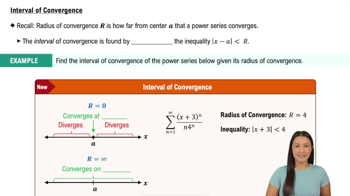
Interval of Convergence

The interval of convergence is the set of x-values for which a power series converges. To find it, we typically use the Ratio or Root Test to determine where the series converges absolutely. This interval may be open, closed, or half-open depending on endpoint behavior.
Recommended video:
08:44
Interval of Convergence

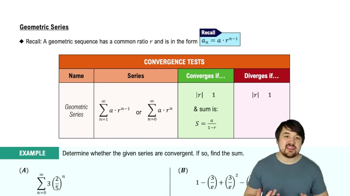
Theorem 20 (Geometric Series Sum Formula)

Theorem 20 states that a geometric series ∑ arⁿ converges to a/(1 - r) if |r| < 1. Recognizing the given series as geometric allows us to find its sum function by identifying the common ratio and applying this formula within the interval of convergence.
Recommended video:
06:00
Geometric Series

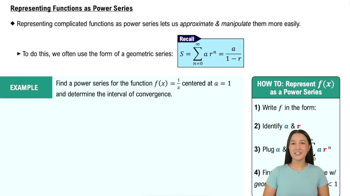
Power Series and Function Representation

A power series represents a function as an infinite sum of terms involving powers of (x - c). Understanding how to express a series as a function helps in analyzing its behavior and finding closed-form expressions, which is essential for interpreting the sum within the interval of convergence.
Recommended video:
07:32
Representing Functions as Power Series