Ch. 10 - Infinite Sequences and Series
Hass - Thomas' Calculus 15th Edition
Hass15th EditionThomas' CalculusISBN: 9780137616077Not the one you use?Change textbook
Chapter 10, Problem 10.4.5

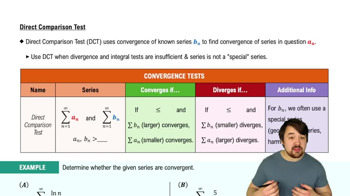
Direct Comparison Test
In Exercises 1–8, use the Direct Comparison Test to determine if each series converges or diverges.
∑ (from n=1 to ∞) cos²n / n^(3/2)

Verified step by step guidance
1
Identify the given series: \( \sum_{n=1}^{\infty} \frac{\cos^{2} n}{n^{3/2}} \). Notice that the terms involve \( \cos^{2} n \) divided by \( n^{3/2} \).
Recall the Direct Comparison Test: To use it, we need to compare the given series to a known benchmark series \( \sum b_n \) where \( b_n \) is positive and whose convergence behavior is known.
Since \( \cos^{2} n \) oscillates between 0 and 1, we know \( 0 \leq \cos^{2} n \leq 1 \) for all \( n \). Therefore, each term of the series satisfies \( 0 \leq \frac{\cos^{2} n}{n^{3/2}} \leq \frac{1}{n^{3/2}} \).
Compare the given series to the p-series \( \sum_{n=1}^{\infty} \frac{1}{n^{3/2}} \). Since \( p = \frac{3}{2} > 1 \), this p-series converges.
By the Direct Comparison Test, since \( 0 \leq \frac{\cos^{2} n}{n^{3/2}} \leq \frac{1}{n^{3/2}} \) and \( \sum \frac{1}{n^{3/2}} \) converges, the original series \( \sum \frac{\cos^{2} n}{n^{3/2}} \) also converges.

Verified video answer for a similar problem:

This video solution was recommended by our tutors as helpful for the problem above.
Video duration:
5m
Was this helpful?

Key Concepts

Here are the essential concepts you must grasp in order to answer the question correctly.

Direct Comparison Test

The Direct Comparison Test determines the convergence or divergence of a series by comparing it to another series with known behavior. If 0 ≤ a_n ≤ b_n for all n and ∑b_n converges, then ∑a_n also converges. Conversely, if a_n ≥ b_n ≥ 0 and ∑b_n diverges, then ∑a_n diverges.
Recommended video:
09:25
Direct Comparison Test

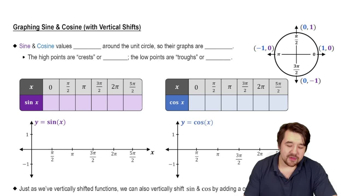
Behavior of the Cosine Function

The term cos²(n) oscillates between 0 and 1 for all integer n. Since cos²(n) is always non-negative and bounded above by 1, it can be used to compare the given series to a simpler series by replacing cos²(n) with its upper bound.
Recommended video:
5:53
Graph of Sine and Cosine Function

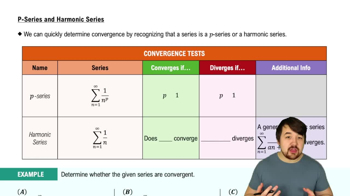
p-Series Test

A p-series ∑ 1/n^p converges if and only if p > 1 and diverges otherwise. In this problem, the denominator n^(3/2) corresponds to p = 3/2, which is greater than 1, so the p-series converges. This fact helps in comparing the given series to a convergent p-series.
Recommended video:
04:30
P-Series and Harmonic Series