
Ch. 1 - Functions
Hass - Thomas' Calculus 15th Edition
Hass15th EditionThomas' CalculusISBN: 9780137616077Not the one you use?Change textbook
Chapter 1, Problem 1.3.38

What happens if you take B = 2π in the addition formulas? Do the results agree with something you already know?

Verified step by step guidance
1
Consider the addition formulas for sine and cosine: \( \sin(A + B) = \sin A \cos B + \cos A \sin B \) and \( \cos(A + B) = \cos A \cos B - \sin A \sin B \).
Substitute \( B = 2\pi \) into these formulas. Recall that \( \cos(2\pi) = 1 \) and \( \sin(2\pi) = 0 \).
For the sine addition formula, substitute \( B = 2\pi \): \( \sin(A + 2\pi) = \sin A \cdot 1 + \cos A \cdot 0 = \sin A \).
For the cosine addition formula, substitute \( B = 2\pi \): \( \cos(A + 2\pi) = \cos A \cdot 1 - \sin A \cdot 0 = \cos A \).
These results show that \( \sin(A + 2\pi) = \sin A \) and \( \cos(A + 2\pi) = \cos A \), which agree with the periodicity of sine and cosine functions, confirming that they repeat every \( 2\pi \).

Verified video answer for a similar problem:

This video solution was recommended by our tutors as helpful for the problem above.
Video duration:
7m
Was this helpful?

Key Concepts

Here are the essential concepts you must grasp in order to answer the question correctly.

Addition Formulas

Addition formulas in trigonometry express the sine and cosine of the sum or difference of two angles. For example, the sine addition formula states that sin(a + b) = sin(a)cos(b) + cos(a)sin(b). These formulas are essential for simplifying expressions involving trigonometric functions and for solving equations that include angles.
Recommended video:
05:56
Additional Rules for Indefinite Integrals

Periodic Functions

Trigonometric functions such as sine and cosine are periodic, meaning they repeat their values in regular intervals. The period of sine and cosine is 2π, which indicates that sin(x + 2π) = sin(x) and cos(x + 2π) = cos(x). Understanding periodicity is crucial when analyzing the behavior of trigonometric functions over different intervals.
Recommended video:
6:22
Graphs of Secant and Cosecant Functions

Unit Circle

The unit circle is a circle with a radius of one centered at the origin of a coordinate plane. It provides a geometric interpretation of trigonometric functions, where the x-coordinate represents the cosine and the y-coordinate represents the sine of an angle. Using the unit circle helps visualize how angles relate to their sine and cosine values, especially when considering angles like B = 2π.
Recommended video:
5:10
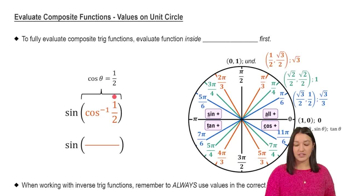
Evaluate Composite Functions - Values on Unit Circle