Ch. 1 - Functions
Hass - Thomas' Calculus 15th Edition
Hass15th EditionThomas' CalculusISBN: 9780137616077Not the one you use?Change textbook
Chapter 1, Problem 1.2.21

Composition of Functions


A balloon’s volume V is given by V = s² + 2s + 3 cm³, where s is the ambient temperature in °C. The ambient temperature s at time t minutes is given by s = 2t − 3 °C. Write the balloon’s volume V as a function of time t.

Verified step by step guidance
1
Identify the given functions: The volume of the balloon is given by \( V = s^2 + 2s + 3 \) and the ambient temperature is given by \( s = 2t - 3 \).
Recognize that you need to find the composition of functions, specifically \( V(s(t)) \), which means substituting the expression for \( s \) into the volume function \( V \).
Substitute \( s = 2t - 3 \) into the volume function \( V = s^2 + 2s + 3 \). This gives \( V = (2t - 3)^2 + 2(2t - 3) + 3 \).
Expand the expression \( (2t - 3)^2 \) using the formula \( (a - b)^2 = a^2 - 2ab + b^2 \). This results in \( 4t^2 - 12t + 9 \).
Combine all terms: \( V = 4t^2 - 12t + 9 + 4t - 6 + 3 \). Simplify the expression to write the volume \( V \) as a function of time \( t \).

Verified video answer for a similar problem:

This video solution was recommended by our tutors as helpful for the problem above.
Video duration:
2m
Was this helpful?

Key Concepts

Here are the essential concepts you must grasp in order to answer the question correctly.

Composition of Functions

Composition of functions involves combining two functions to create a new function. In this case, we have two functions: the volume V as a function of temperature s, and the temperature s as a function of time t. To find V as a function of t, we substitute the expression for s into the equation for V, effectively creating a new function that relates volume directly to time.
Recommended video:
3:48
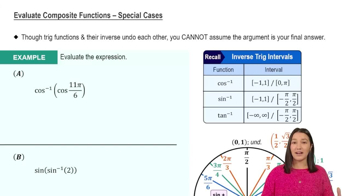
Evaluate Composite Functions - Special Cases

Quadratic Functions

A quadratic function is a polynomial function of degree two, typically expressed in the form V = ax² + bx + c. In the given volume equation V = s² + 2s + 3, the variable s is raised to the second power, indicating that the volume changes in a parabolic manner with respect to temperature. Understanding the properties of quadratic functions, such as their vertex and axis of symmetry, is essential for analyzing their behavior.
Recommended video:
6:04
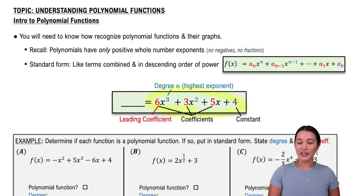
Introduction to Polynomial Functions

Substitution Method

The substitution method is a technique used in algebra and calculus to simplify expressions or solve equations by replacing a variable with another expression. In this problem, we substitute the expression for s (temperature) into the volume equation V. This method allows us to express V solely in terms of t (time), facilitating the analysis of how the balloon's volume changes over time.
Recommended video:
04:27
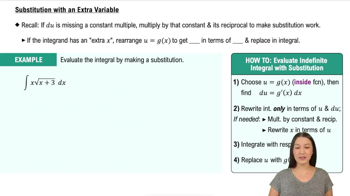
Substitution With an Extra Variable