Ch. 1 - Functions
Hass - Thomas' Calculus 15th Edition
Hass15th EditionThomas' CalculusISBN: 9780137616077Not the one you use?Change textbook
Chapter 1, Problem 14

Graph the functions in Exercises 13–22. What is the period of each function?


sin (x/2)

Verified step by step guidance
1
Identify the function: The function given is \( \sin(\frac{x}{2}) \). This is a sine function with a modified argument.
Determine the period of the sine function: The standard period of \( \sin(x) \) is \( 2\pi \). For \( \sin(\frac{x}{2}) \), the period is affected by the coefficient of \( x \) inside the sine function.
Calculate the new period: The period of \( \sin(kx) \) is \( \frac{2\pi}{|k|} \). Here, \( k = \frac{1}{2} \), so the period is \( \frac{2\pi}{\frac{1}{2}} = 4\pi \).
Graph the function: Start by plotting the key points of the sine function over one period \([0, 4\pi]\). These points include the intercepts, maximum, and minimum values.
Label the graph: Clearly indicate the period on the x-axis, and mark the amplitude (which remains 1 for this function) on the y-axis. The graph should show the wave completing one full cycle over the interval \([0, 4\pi]\).

Verified video answer for a similar problem:

This video solution was recommended by our tutors as helpful for the problem above.
Video duration:
8m
Was this helpful?

Key Concepts

Here are the essential concepts you must grasp in order to answer the question correctly.

Period of a Function

The period of a function is the length of the interval over which the function repeats itself. For trigonometric functions like sine and cosine, the period is a key characteristic that determines how often the wave pattern occurs. For example, the standard sine function, sin(x), has a period of 2π, meaning it repeats every 2π units along the x-axis.
Recommended video:
6:22
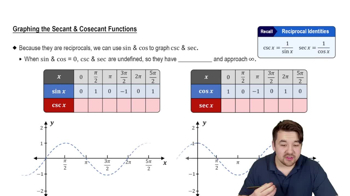
Graphs of Secant and Cosecant Functions

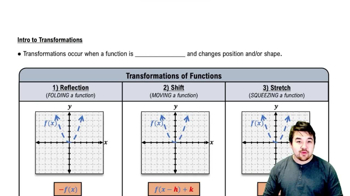
Transformation of Functions

Transformations involve changes to the basic form of a function, such as stretching, compressing, or shifting. In the case of sin(x/2), the 'x/2' indicates a horizontal stretch, which affects the period. Specifically, dividing the input by a factor (like 2) increases the period, resulting in a new period of 4π for sin(x/2).
Recommended video:
5:25
Intro to Transformations

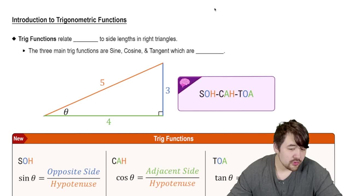
Graphing Trigonometric Functions

Graphing trigonometric functions requires understanding their key features, including amplitude, period, and phase shift. For sin(x/2), the graph will oscillate between -1 and 1, with a period of 4π, meaning it will complete one full cycle over this interval. Recognizing these features helps in accurately sketching the function and predicting its behavior.
Recommended video:
6:04
Introduction to Trigonometric Functions