Ch. 1 - Functions
Hass - Thomas' Calculus 15th Edition
Hass15th EditionThomas' CalculusISBN: 9780137616077Not the one you use?Change textbook
Chapter 1, Problem 21

Graph the functions in Exercises 13–22. What is the period of each function?


sin (x − π/4) + 1

Verified step by step guidance
1
Identify the function to be graphed: \( f(x) = \sin(x - \frac{\pi}{4}) + 1 \). This is a transformation of the basic sine function.
Determine the horizontal shift: The term \( x - \frac{\pi}{4} \) indicates a phase shift to the right by \( \frac{\pi}{4} \) units.
Determine the vertical shift: The '+1' outside the sine function indicates a vertical shift upwards by 1 unit.
Identify the period of the function: The period of the basic sine function \( \sin(x) \) is \( 2\pi \). Since there is no coefficient affecting the \( x \) inside the sine function, the period remains \( 2\pi \).
Graph the function: Start by plotting the basic sine curve, apply the horizontal shift to the right by \( \frac{\pi}{4} \), and then shift the entire graph upwards by 1 unit. The resulting graph will have the same shape as the sine curve but will be shifted accordingly.

Verified video answer for a similar problem:

This video solution was recommended by our tutors as helpful for the problem above.
Video duration:
8m
Was this helpful?

Key Concepts

Here are the essential concepts you must grasp in order to answer the question correctly.

Period of a Function

The period of a function is the length of the interval over which the function repeats itself. For trigonometric functions like sine and cosine, the period is a key characteristic that determines how often the function cycles through its values. For the sine function, the standard period is 2π, meaning it completes one full cycle over this interval.
Recommended video:
6:22
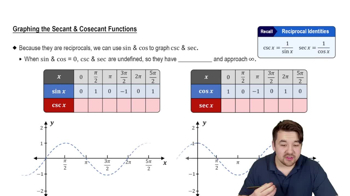
Graphs of Secant and Cosecant Functions

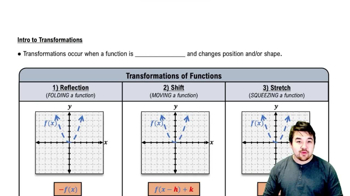
Transformation of Functions

Transformations involve shifting, stretching, or compressing the graph of a function. In the given function sin(x − π/4) + 1, the term (x − π/4) indicates a horizontal shift to the right by π/4 units, while the +1 indicates a vertical shift upward by 1 unit. Understanding these transformations is essential for accurately graphing the function.
Recommended video:
5:25
Intro to Transformations

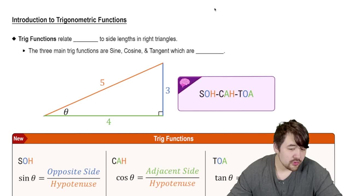
Graphing Trigonometric Functions

Graphing trigonometric functions requires knowledge of their basic shapes and how transformations affect these shapes. The sine function typically oscillates between -1 and 1, and when transformed, its amplitude and vertical position can change. For sin(x − π/4) + 1, the graph will oscillate between 0 and 2, reflecting the vertical shift.
Recommended video:
6:04
Introduction to Trigonometric Functions