Ch.12 - Parametric and Polar Curves
Briggs - Calculus: Early Transcendentals 3rd Edition
Briggs3rd EditionCalculus: Early TranscendentalsISBN: 9780136847243Not the one you use?Change textbook
Chapter 12, Problem 12.1.64

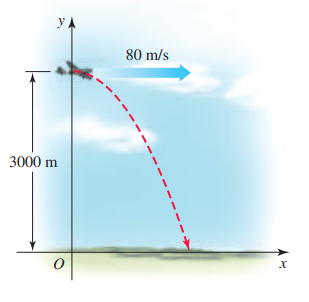
Air drop A plane traveling horizontally at 80 m/s over flat ground at an elevation of 3000 m releases an emergency packet. The trajectory of the packet is given by
x = 80t, y = −4.9t² + 3000, t ≥ 0
where the origin is the point on the ground directly beneath the plane at the moment of the release (see figure). Graph the trajectory of the packet and find the coordinates of the point where the packet lands.
Graph showing a plane at 3000 m height releasing a packet moving horizontally at 80 m/s with a parabolic descent.

Verified step by step guidance
1
Step 1: Understand the given parametric equations for the trajectory of the packet: \(x = 80t\) and \(y = -4.9t^{2} + 3000\), where \(t \geq 0\). Here, \(x\) represents the horizontal distance from the origin, and \(y\) represents the height above the ground.
Step 2: To graph the trajectory, create a table of values by choosing several values of \(t\) (starting from 0) and calculating the corresponding \(x\) and \(y\) coordinates using the given equations. Plot these points on the coordinate plane.
Step 3: To find the point where the packet lands, determine when the packet reaches the ground, i.e., when \(y = 0\). Set the equation \(-4.9t^{2} + 3000 = 0\) and solve for \(t\).
Step 4: Once you find the time \(t\) when the packet hits the ground, substitute this value back into the horizontal position equation \(x = 80t\) to find the horizontal distance from the origin where the packet lands.
Step 5: The coordinates of the landing point are then \((x, 0)\), where \(x\) is the horizontal distance calculated in Step 4. This point represents where the packet touches the ground.

Verified video answer for a similar problem:

This video solution was recommended by our tutors as helpful for the problem above.
Video duration:
4m
Was this helpful?

Key Concepts

Here are the essential concepts you must grasp in order to answer the question correctly.

Parametric Equations

Parametric equations express the coordinates of a point as functions of a parameter, often time (t). In this problem, x and y are given as functions of t, describing the horizontal and vertical positions of the packet over time, allowing us to analyze its trajectory.
Recommended video:
Guided course
08:02
Parameterizing Equations

Projectile Motion

Projectile motion describes the path of an object under the influence of gravity, moving in two dimensions. The horizontal motion is uniform (constant velocity), while the vertical motion is uniformly accelerated (due to gravity), resulting in a parabolic trajectory.
Recommended video:
06:51
Derivatives Applied To Acceleration Example 2

Finding the Landing Point

To find where the packet lands, we determine when the vertical position y equals zero (ground level). Solving y = 0 for t gives the time of landing, which is then substituted into x(t) to find the horizontal distance traveled.
Recommended video:
04:50
Critical Points