
Ch.12 - Parametric and Polar Curves
Briggs - Calculus: Early Transcendentals 3rd Edition
Briggs3rd EditionCalculus: Early TranscendentalsISBN: 9780136847243Not the one you use?Change textbook
Chapter 12, Problem 71

63–74. Arc length of polar curves Find the length of the following polar curves.


The curve r = sin³(θ/3), for 0 ≤ θ ≤ π/2

Verified step by step guidance
1
Recall the formula for the arc length \( L \) of a polar curve \( r = r(\theta) \) from \( \theta = a \) to \( \theta = b \): \[ L = \int_a^b \sqrt{r(\theta)^2 + \left(\frac{d r}{d \theta}\right)^2} \, d\theta \]
Identify the given function and interval: \( r(\theta) = \sin^3\left(\frac{\theta}{3}\right) \) and \( \theta \) ranges from 0 to \( \frac{\pi}{2} \).
Compute the derivative \( \frac{d r}{d \theta} \) using the chain rule: First, write \( r(\theta) = \left( \sin\left(\frac{\theta}{3}\right) \right)^3 \). Then, \[ \frac{d r}{d \theta} = 3 \sin^2\left(\frac{\theta}{3}\right) \cdot \cos\left(\frac{\theta}{3}\right) \cdot \frac{1}{3} = \sin^2\left(\frac{\theta}{3}\right) \cos\left(\frac{\theta}{3}\right) \]
Substitute \( r(\theta) \) and \( \frac{d r}{d \theta} \) into the arc length formula: \[ L = \int_0^{\frac{\pi}{2}} \sqrt{ \sin^6\left(\frac{\theta}{3}\right) + \left( \sin^2\left(\frac{\theta}{3}\right) \cos\left(\frac{\theta}{3}\right) \right)^2 } \, d\theta \]
Simplify the expression inside the square root if possible, then evaluate the integral over the interval \( 0 \leq \theta \leq \frac{\pi}{2} \) to find the arc length.

Verified video answer for a similar problem:

This video solution was recommended by our tutors as helpful for the problem above.
Video duration:
4m
Was this helpful?

Key Concepts

Here are the essential concepts you must grasp in order to answer the question correctly.

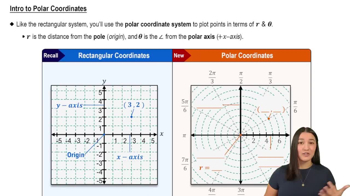
Polar Coordinates and Curves

Polar coordinates represent points in the plane using a radius and an angle (r, θ). Polar curves are defined by equations relating r and θ, such as r = sin³(θ/3). Understanding how to interpret and plot these curves is essential for analyzing their properties, including length.
Recommended video:
05:32
Intro to Polar Coordinates

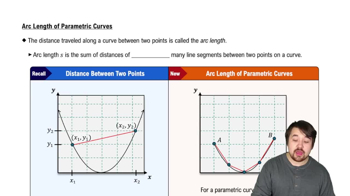
Arc Length Formula for Polar Curves

The arc length of a polar curve r(θ) from θ = a to θ = b is given by the integral ∫ₐᵇ √[r(θ)² + (dr/dθ)²] dθ. This formula accounts for changes in both radius and angle, allowing calculation of the curve's length by integrating over the specified interval.
Recommended video:
06:29
Arc Length of Parametric Curves

Differentiation of Polar Functions

To apply the arc length formula, one must compute the derivative dr/dθ accurately. This involves differentiating functions like r = sin³(θ/3) using the chain rule and power rule, which is crucial for evaluating the integral that determines the curve's length.
Recommended video:
05:32
Intro to Polar Coordinates