
Ch.12 - Parametric and Polar Curves
Briggs - Calculus: Early Transcendentals 3rd Edition
Briggs3rd EditionCalculus: Early TranscendentalsISBN: 9780136847243Not the one you use?Change textbook
Chapter 12, Problem 12.1.43

37–52. Curves to parametric equations Find parametric equations for the following curves. Include an interval for the parameter values. Answers are not unique.


The segment of the parabola y=2x ²−4, where −1≤x≤5

Verified step by step guidance
1
Identify the given curve equation: \(y = 2x^{2} - 4\) and the domain for \(x\) is \(-1 \leq x \leq 5\).
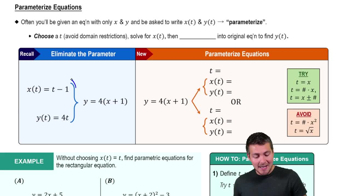
Choose a parameter to represent \(x\). A natural choice is to let the parameter \(t\) equal \(x\), so set \(x = t\).
Express \(y\) in terms of the parameter \(t\) by substituting \(x = t\) into the equation: \(y = 2t^{2} - 4\).
Write the parametric equations as \(x = t\) and \(y = 2t^{2} - 4\) with the parameter interval \(-1 \leq t \leq 5\).
Verify that the parametric equations describe the segment of the parabola by checking that as \(t\) varies over the interval, the points \((x,y)\) trace the curve segment.

Verified video answer for a similar problem:

This video solution was recommended by our tutors as helpful for the problem above.
Video duration:
1m
Was this helpful?

Key Concepts

Here are the essential concepts you must grasp in order to answer the question correctly.

Parametric Equations

Parametric equations express the coordinates of points on a curve as functions of a third variable, called the parameter. Instead of y as a function of x, both x and y are defined in terms of a parameter t, allowing more flexible representations of curves, including segments and complex shapes.
Recommended video:
Guided course
08:02
Parameterizing Equations

Interval of the Parameter

The interval of the parameter defines the range of values that the parameter t can take, which corresponds to the portion of the curve being described. Choosing the correct interval ensures the parametric equations represent only the desired segment of the curve, such as restricting x between -1 and 5.
Recommended video:
Guided course
05:59
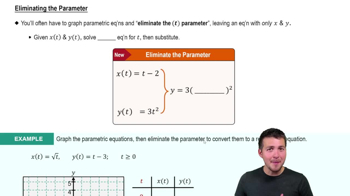
Eliminating the Parameter

Converting Cartesian to Parametric Form

To convert a Cartesian equation like y = 2x² - 4 into parametric form, assign the parameter t to x (e.g., x = t), then express y in terms of t using the original equation (y = 2t² - 4). This method directly translates the curve into parametric equations, with t varying over the specified x-interval.
Recommended video:
Guided course
05:59
Eliminating the Parameter