Ch.12 - Parametric and Polar Curves
Briggs - Calculus: Early Transcendentals 3rd Edition
Briggs3rd EditionCalculus: Early TranscendentalsISBN: 9780136847243Not the one you use?Change textbook
Chapter 12, Problem 12.R.56c

53–57. Conic sections
c. Find the eccentricity of the curve.
x²/4 + y²/25 = 1

Verified step by step guidance
1
Identify the type of conic section given by the equation \(\frac{x^{2}}{4} + \frac{y^{2}}{25} = 1\). Since both \(x^{2}\) and \(y^{2}\) terms are positive and the equation equals 1, this is an ellipse.
Recall the standard form of an ellipse centered at the origin: \(\frac{x^{2}}{a^{2}} + \frac{y^{2}}{b^{2}} = 1\), where \(a\) and \(b\) are the semi-major and semi-minor axes. Determine which denominator is larger to identify \(a^{2}\) and \(b^{2}\).
Assign \(a^{2} = 25\) and \(b^{2} = 4\) because 25 is greater than 4, so \(a = 5\) and \(b = 2\). The major axis is along the \(y\)-axis since \(a^{2}\) is under \(y^{2}\).
Use the formula for the eccentricity \(e\) of an ellipse: \(e = \frac{c}{a}\), where \(c\) is the distance from the center to a focus. Calculate \(c\) using \(c^{2} = a^{2} - b^{2}\).
Substitute the values of \(a^{2}\) and \(b^{2}\) into \(c^{2} = a^{2} - b^{2}\) to find \(c\), then compute \(e = \frac{c}{a}\). This will give the eccentricity of the ellipse.

Verified video answer for a similar problem:

This video solution was recommended by our tutors as helpful for the problem above.
Video duration:
2m
Was this helpful?

Key Concepts

Here are the essential concepts you must grasp in order to answer the question correctly.

Equation of an Ellipse

An ellipse is defined by the equation (x²/a²) + (y²/b²) = 1, where a and b are the lengths of the semi-major and semi-minor axes. Identifying which axis is major or minor depends on the relative sizes of a and b. This form helps in understanding the shape and orientation of the ellipse.
Recommended video:
Guided course
06:03
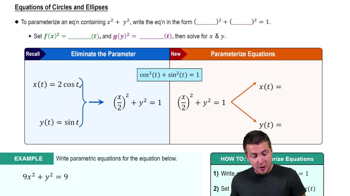
Parameterizing Equations of Circles & Ellipses

Eccentricity of an Ellipse

Eccentricity (e) measures how much an ellipse deviates from being a circle, calculated as e = √(1 - (b²/a²)) when a > b. It ranges from 0 (circle) to 1 (parabola). Knowing eccentricity helps describe the ellipse's shape and its geometric properties.
Recommended video:
5:30
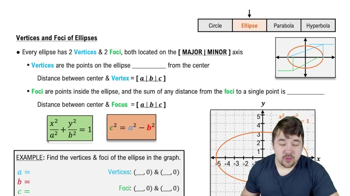
Foci and Vertices of an Ellipse

Identifying Major and Minor Axes

In the ellipse equation, the larger denominator corresponds to the square of the semi-major axis (a²), and the smaller to the semi-minor axis (b²). Correctly identifying these axes is essential for calculating eccentricity and understanding the ellipse's geometry.
Recommended video:
5:12
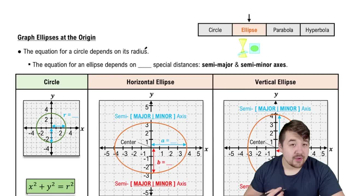
Graph Ellipses at Origin