
Textbook Question
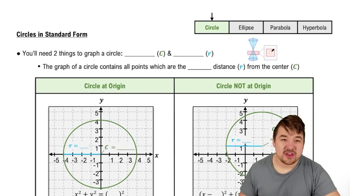
General equations for a circle Prove that the equations
X = a cos t + b sin t, y = c cos t + d sin t
where a, b, c, and d are real numbers, describe a circle of radius R provided a² +c² =b² +d² = R² and ab+cd=0.
1
views

 Verified step by step guidance
 5:33
5:33
 5:18
5:18 5:30
5:30General equations for a circle Prove that the equations
X = a cos t + b sin t, y = c cos t + d sin t
where a, b, c, and d are real numbers, describe a circle of radius R provided a² +c² =b² +d² = R² and ab+cd=0.
51–52. {Use of Tech} Arc length of polar curves Find the approximate length of the following curves.
The limaçon r=3−6cosθ
53–57. Conic sections
c. Find the eccentricity of the curve.
x²/4 + y²/25 = 1
3–6. Eliminating the parameter Eliminate the parameter to find a description of the following curves in terms of x and y. Give a geometric description and the positive orientation of the curve.
x = sin t - 3, y = cos t + 6; 0 ≤ t ≤ π
27–32. Polar curves Graph the following equations.
r = 3 sin 4θ
Explain why or why not Determine whether the following statements are true and give an explanation or counterexample.
c. The polar coordinates (3, -3π/4) and (-3, π/4) describe the same point in the plane.