Ch.12 - Parametric and Polar Curves
Briggs - Calculus: Early Transcendentals 3rd Edition
Briggs3rd EditionCalculus: Early TranscendentalsISBN: 9780136847243Not the one you use?Change textbook
Chapter 12, Problem 12.3.31

29–32. Intersection points Use algebraic methods to find as many intersection points of the following curves as possible. Use graphical methods to identify the remaining intersection points.


r = 1 and r = 2 sin 2θ

Verified step by step guidance
1
Start by setting the two polar equations equal to each other to find their intersection points: \(1 = 2 \sin(2\theta)\).
Solve the equation \(1 = 2 \sin(2\theta)\) for \(\sin(2\theta)\), which gives \(\sin(2\theta) = \frac{1}{2}\).
Find the general solutions for \(2\theta\) using the inverse sine function: \(2\theta = \sin^{-1}\left(\frac{1}{2}\right)\) plus all possible angles considering the periodicity of sine.
Divide the solutions for \(2\theta\) by 2 to get the corresponding values of \(\theta\) where the curves intersect.
Substitute these \(\theta\) values back into either original equation to find the corresponding \(r\) values, confirming the intersection points in polar coordinates.

Verified video answer for a similar problem:

This video solution was recommended by our tutors as helpful for the problem above.
Video duration:
3m
Was this helpful?

Key Concepts

Here are the essential concepts you must grasp in order to answer the question correctly.

Polar Coordinates and Equations

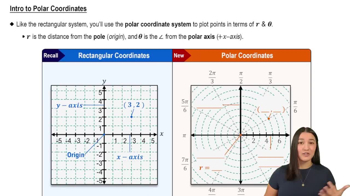
Polar coordinates represent points using a radius and an angle (r, θ) instead of Cartesian (x, y). Understanding how to interpret and manipulate polar equations like r = 1 and r = 2 sin 2θ is essential for finding intersection points between curves defined in this system.
Recommended video:
05:32
Intro to Polar Coordinates

Solving Equations for Intersection Points

Finding intersection points involves setting the two polar equations equal to each other and solving for θ and r. This requires algebraic manipulation and sometimes trigonometric identities to find all possible solutions where the curves meet.
Recommended video:
5:02
Solving Logarithmic Equations

Graphical Methods for Intersection Identification

Graphical methods involve plotting the polar curves to visually identify intersection points that may be difficult to find algebraically. This approach helps confirm solutions and locate additional intersections by analyzing the shape and symmetry of the curves.
Recommended video:
07:33
Euler's Method