Ch. 9 - Differential Equations
Briggs - Calculus: Early Transcendentals 3rd Edition
Briggs3rd EditionCalculus: Early TranscendentalsISBN: 9780136847243Not the one you use?Change textbook
Chapter 9, Problem 9.3.47c

{Use of Tech} Free fall An object in free fall may be modeled by assuming the only forces at work are the gravitational force and air resistance. By Newton’s Second Law of Motion (mass end . acceleration = the sum of external forces), the velocity of the object satisfies the differential equation 


m · v'(t) = mg + f(v)
mass | acceleration | external forces


where f is a function that models the air resistance (assuming the positive direction is downward). One common assumption (often used for motion in air) is that f(v)=−kv^2, for t≥0, where k>0 is a drag coefficient.


c. Find the solution of this separable equation assuming v(0)=0 and 0<v²<g/a. 

Verified step by step guidance
1
Start with the given differential equation: \(m \cdot v'(t) = mg + f(v)\), where \(f(v) = -kv^2\). Substitute \(f(v)\) to get \(m \cdot v'(t) = mg - kv^2\).
Rewrite the equation to isolate \(v'(t)\): \(v'(t) = g - \frac{k}{m} v^2\). This is a separable differential equation.
Separate variables by writing \(\frac{dv}{dt} = g - \frac{k}{m} v^2\) as \(\frac{dv}{g - \frac{k}{m} v^2} = dt\).
Integrate both sides: integrate the left side with respect to \(v\) and the right side with respect to \(t\). The integral on the left involves a rational function of \(v^2\), which can be handled using a trigonometric substitution or recognizing it as a standard integral form.
Apply the initial condition \(v(0) = 0\) to solve for the constant of integration after performing the integration, and express \(v\) explicitly as a function of \(t\).

Verified video answer for a similar problem:

This video solution was recommended by our tutors as helpful for the problem above.
Video duration:
7m
Was this helpful?

Key Concepts

Here are the essential concepts you must grasp in order to answer the question correctly.

Newton's Second Law and Differential Equations

Newton's Second Law states that mass times acceleration equals the sum of external forces. In this problem, it leads to a differential equation relating velocity and time. Understanding how to translate physical laws into differential equations is essential for modeling motion under forces like gravity and air resistance.
Recommended video:
10:44
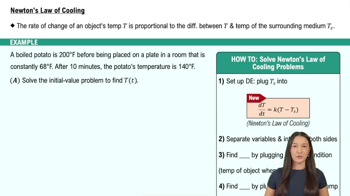
Newton's Law of Cooling

Separable Differential Equations

A separable differential equation can be written so that all terms involving the dependent variable are on one side and all terms involving the independent variable are on the other. This allows integration on both sides to find the solution. Recognizing and solving separable equations is key to finding velocity as a function of time here.
Recommended video:
06:06
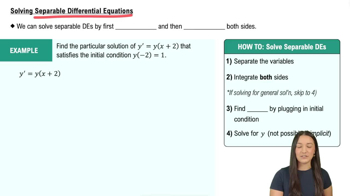
Solving Separable Differential Equations

Modeling Air Resistance as a Quadratic Drag Force

Air resistance is often modeled as a force proportional to the square of velocity, expressed as f(v) = -kv², where k > 0 is the drag coefficient. This nonlinear term affects the acceleration and velocity, making the differential equation nonlinear. Understanding this model helps in setting up and solving the equation for velocity under drag.
Recommended video:
09:29
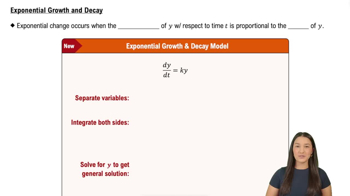
Exponential Growth & Decay
Related Practice
Textbook Question

33–36. {Use of Tech} Computing Euler approximations Use a calculator or computer program to carry out the following steps.

b. Using the exact solution (also given), find the error in the approximation to y(T) (only at the right endpoint of the time interval).


y′(t) = t/y, y(0) = 4; Δt = 0.1, T = 2; y(t) = √(t² + 16)

1
views
Textbook Question

52-56. In this section, several models are presented and the solution of the associated differential equation is given. Later in the chapter, we present methods for solving these differential equations.


(Use of Tech) Chemical rate equations The reaction of certain chemical compounds can be modeled using a differential equation of the form y'(t) = -kyⁿ(t), where y(t) is the concentration of the compound, for t ≥ 0, k > 0 is a constant that determines the speed of the reaction, and n is a positive integer called the order of the reaction. Assume the initial concentration of the compound is y(0) = y₀ > 0.


c. Let y₀ = 1 and k = 0.1. Graph the first-order and second-order solutions found in parts (a) and (b). Compare the two reactions. 

Textbook Question

Euler’s method on more general grids Suppose the solution of the initial value problem y'(t)=f(t,y),y(a)=A is to be approximated on the interval [a, b].

b. Write the first step of Euler’s method to compute u1.

Textbook Question

Direction field analysis Consider the first-order initial value problem y'(t)=ay+b,y(0)=A for t≥0 where a, b, and A are real numbers.

c. Draw a representative direction field in the case that a<0. Show that if A>−b/a, then the solution decreases for t≥0, and that if A<−b/a, then the solution increases for t≥0.

1
views
Textbook Question

Explain why or why not Determine whether the following statements are true and give an explanation or counterexample.

c. The general solution of the equation yy'(x) = xe⁻ʸ can be found using integration by parts.

Textbook Question

52-56. In this section, several models are presented and the solution of the associated differential equation is given. Later in the chapter, we present methods for solving these differential equations.


{Use of Tech} Free fall One possible model that describes the free fall of an object in a gravitational field subject to air resistance uses the equation v'(t) = g - bv, where v(t) is the velocity of the object for t ≥ 0, g = 9.8 m/s² is the acceleration due to gravity, and b > 0 is a constant that involves the mass of the object and the air resistance.


c. Using the graph in part (b), estimate the terminal velocity lim(t→∞) v(t).