
Ch. 9 - Differential Equations
Briggs - Calculus: Early Transcendentals 3rd Edition
Briggs3rd EditionCalculus: Early TranscendentalsISBN: 9780136847243Not the one you use?Change textbook
Chapter 9, Problem 9.2.45b

Euler’s method on more general grids Suppose the solution of the initial value problem y'(t)=f(t,y),y(a)=A is to be approximated on the interval [a, b].
b. Write the first step of Euler’s method to compute u1.

Verified step by step guidance
1
Recall that Euler's method is a numerical technique to approximate the solution of the initial value problem \(y'(t) = f(t, y)\) with initial condition \(y(a) = A\) over the interval \([a, b]\).
Choose a step size \(h = t_1 - t_0\), where \(t_0 = a\) and \(t_1\) is the next point in the grid where we want to approximate the solution.
The first approximation \(u_0\) is given by the initial condition: \(u_0 = A\).
Use the Euler's method formula to compute the next value \(u_1\): \[u_1 = u_0 + h \cdot f(t_0, u_0)\]
This formula means you take the current value \(u_0\) and add the product of the step size \(h\) and the slope \(f(t_0, u_0)\) to estimate the solution at \(t_1\).

Verified video answer for a similar problem:

This video solution was recommended by our tutors as helpful for the problem above.
Video duration:
3m
Was this helpful?

Key Concepts

Here are the essential concepts you must grasp in order to answer the question correctly.

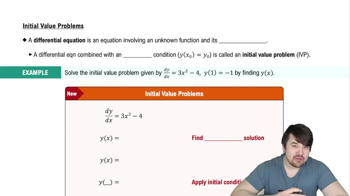
Initial Value Problem (IVP)

An initial value problem involves finding a function y(t) that satisfies a differential equation y'(t) = f(t, y) along with a given initial condition y(a) = A. The solution is sought over an interval [a, b], starting from the known initial value.
Recommended video:
05:03
Initial Value Problems

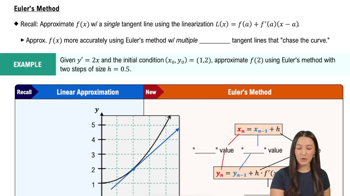
Euler’s Method

Euler’s method is a numerical technique to approximate solutions of differential equations by using tangent line approximations. Starting from the initial point, it estimates the next value by moving along the slope given by f(t, y) multiplied by a step size.
Recommended video:
07:33
Euler's Method

Step Size and Grid Points

The interval [a, b] is divided into discrete points called a grid, where the step size determines the distance between these points. In Euler’s method, the step size affects the accuracy of the approximation, and the first step computes u1 using the initial value and the slope at the initial point.
Recommended video:
04:50
Critical Points
Related Practice
Textbook Question

33–36. {Use of Tech} Computing Euler approximations Use a calculator or computer program to carry out the following steps.

b. Using the exact solution (also given), find the error in the approximation to y(T) (only at the right endpoint of the time interval).


y′(t) = t/y, y(0) = 4; Δt = 0.1, T = 2; y(t) = √(t² + 16)

1
views
Textbook Question

Explain why or why not Determine whether the following statements are true and give an explanation or counterexample.

b. The general solution of the separable equation y'(t) = t/(y' + 10y⁴) can be expressed explicitly with y in terms of t.

1
views
Textbook Question

52-56. In this section, several models are presented and the solution of the associated differential equation is given. Later in the chapter, we present methods for solving these differential equations.


{Use of Tech} Tumor growth The growth of cancer tumors may be modeled by the Gompertz growth equation. Let M(t) be the mass of a tumor, for t ≥ 0. The relevant initial value problem is:


dM/dt = -rM(t)ln(M(t)/K), M(0) = M₀,


where r and K are positive constants and 0 < M₀ < K.


b. Graph the solution for M₀ = 100 and r = 0.05.

Textbook Question

17–20. Increasing and decreasing solutions Consider the following differential equations. A detailed direction field is not needed.


b. In what regions are solutions increasing? Decreasing?


y'(t) = y(y+3)(4-y)

1
views
Textbook Question

{Use of Tech} Free fall An object in free fall may be modeled by assuming the only forces at work are the gravitational force and air resistance. By Newton’s Second Law of Motion (mass end . acceleration = the sum of external forces), the velocity of the object satisfies the differential equation 


m · v'(t) = mg + f(v)

mass | acceleration | external forces


where f is a function that models the air resistance (assuming the positive direction is downward). One common assumption (often used for motion in air) is that f(v)=−kv^2, for t≥0, where k>0 is a drag coefficient.


c. Find the solution of this separable equation assuming v(0)=0 and 0<v²<g/a. 

1
views
Textbook Question

Direction field analysis Consider the first-order initial value problem y'(t)=ay+b,y(0)=A for t≥0 where a, b, and A are real numbers.

c. Draw a representative direction field in the case that a<0. Show that if A>−b/a, then the solution decreases for t≥0, and that if A<−b/a, then the solution increases for t≥0.

1
views