Ch. 9 - Differential Equations
Briggs - Calculus: Early Transcendentals 3rd Edition
Briggs3rd EditionCalculus: Early TranscendentalsISBN: 9780136847243Not the one you use?Change textbook
Chapter 9, Problem 9.R.28b

Logistic growth in India The population of India was 435 million in 1960 (t=0) and 487 million in 1965 (t=5). The projected population for 2050 is 1.57 billion.
b. Use the solution of the logistic equation and the 2050 projected population to determine the carrying capacity.

Verified step by step guidance
1
Recall the general form of the logistic growth model: \[ P(t) = \frac{K}{1 + Ae^{-rt}} \] where \(P(t)\) is the population at time \(t\), \(K\) is the carrying capacity, \(r\) is the growth rate, and \(A\) is a constant related to initial conditions.
Use the initial condition at \(t=0\) (year 1960) where \(P(0) = 435\) million to express \(A\) in terms of \(K\): \[ 435 = \frac{K}{1 + A} \implies A = \frac{K}{435} - 1 \]
Use the population at \(t=5\) (year 1965), \(P(5) = 487\) million, and substitute \(A\( into the logistic equation: \[ 487 = \frac{K}{1 + \left(\frac{K}{435} - 1\right) e^{-5r}} \] This equation relates \)K\) and \(r\).
Use the projected population for 2050, which corresponds to \(t=90\) (since 2050 - 1960 = 90), where \(P(90) = 1570\) million (1.57 billion). Substitute into the logistic model: \[ 1570 = \frac{K}{1 + \left(\frac{K}{435} - 1\right) e^{-90r}} \]
Now you have two equations involving \(K\) and \(r\) from steps 3 and 4. Solve this system of equations simultaneously to find the carrying capacity \(K\).

Verified video answer for a similar problem:

This video solution was recommended by our tutors as helpful for the problem above.
Video duration:
2m
Was this helpful?

Key Concepts

Here are the essential concepts you must grasp in order to answer the question correctly.

Logistic Growth Model

The logistic growth model describes population growth that starts exponentially but slows as it approaches a maximum limit called the carrying capacity. It is represented by a differential equation where growth rate decreases as population nears this limit, modeling realistic constraints like resources.
Recommended video:
09:29
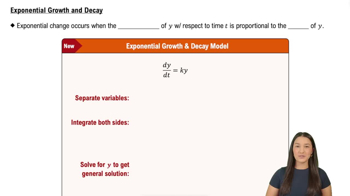
Exponential Growth & Decay

Carrying Capacity

Carrying capacity is the maximum population size that an environment can sustain indefinitely given available resources. In the logistic model, it is the horizontal asymptote that the population approaches over time, representing the stable equilibrium point.
Recommended video:
07:39
Intro to the Chain Rule Example 2

Using Logistic Equation Solutions to Estimate Parameters

Solving the logistic differential equation yields a formula for population over time involving parameters like growth rate and carrying capacity. By substituting known population values at specific times, one can solve for unknown parameters such as the carrying capacity.
Recommended video:
Guided course
04:11
Eliminate Parameter: Equations with Trig