
Textbook Question
Direction fields Consider the direction field for the equation y′=y(2−y) shown in the figure and initial conditions of the form y(0)=A.
a. Sketch a solution on the direction field with the initial condition y(0)=1.

 Verified step by step guidance
 07:39
07:39
 07:33
07:33 04:00
04:00Direction fields Consider the direction field for the equation y′=y(2−y) shown in the figure and initial conditions of the form y(0)=A.
a. Sketch a solution on the direction field with the initial condition y(0)=1.
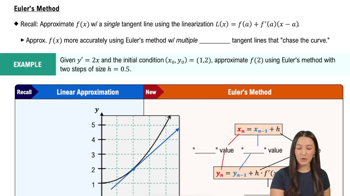
Euler’s metho d Consider the initial value problem y′(t)=1/2y,y(0)=1.
a. Use Euler’s method with Δt=0.1 to compute approximations to y(0.1) and y(0.2).
Logistic growth parameters A cell culture has a population of 20 when a nutrient solution is added at t=0. After 20 hours, the cell population is 80 and the carrying capacity of the culture is estimated to be 1600 cells.
c. After how many hours does the population reach half of the carrying capacity
22–25. Equilibrium solutions Find the equilibrium solutions of the following equations and determine whether each solution is stable or unstable.
y′(t) = y(3+y)(y-5)
Logistic growth in India The population of India was 435 million in 1960 (t=0) and 487 million in 1965 (t=5). The projected population for 2050 is 1.57 billion.
b. Use the solution of the logistic equation and the 2050 projected population to determine the carrying capacity.
2–10. General solutions Use the method of your choice to find the general solution of the following differential equations.
y′(t) = √(y/t)