
Ch. 9 - Differential Equations
Briggs - Calculus: Early Transcendentals 3rd Edition
Briggs3rd EditionCalculus: Early TranscendentalsISBN: 9780136847243Not the one you use?Change textbook
Chapter 9, Problem 9.5.32a

Growth rate functions
a. Show that the logistic growth rate function f(P)=rP(1−P/K) has a maximum value of rK/4 at the point P=K/2.

Verified step by step guidance
1
Start with the logistic growth rate function given by \(f(P) = rP\left(1 - \frac{P}{K}\right)\), where \(r\) and \(K\) are constants, and \(P\) is the variable representing population.
Rewrite the function in a simplified form to make differentiation easier: \(f(P) = rP - \frac{rP^2}{K}\).
Find the critical points by taking the derivative of \(f(P)\) with respect to \(P\) and setting it equal to zero. Compute \(f'(P) = r - \frac{2rP}{K}\) and solve \(f'(P) = 0\) for \(P\).
Solve the equation \(r - \frac{2rP}{K} = 0\) to find the critical point \(P = \frac{K}{2}\).
Verify that this critical point corresponds to a maximum by checking the second derivative \(f''(P) = -\frac{2r}{K}\), which is negative, confirming a maximum at \(P = \frac{K}{2}\). Then, substitute \(P = \frac{K}{2}\) back into the original function to find the maximum value \(f\left(\frac{K}{2}\right) = \frac{rK}{4}\).

Verified video answer for a similar problem:

This video solution was recommended by our tutors as helpful for the problem above.
Video duration:
5m
Was this helpful?

Key Concepts

Here are the essential concepts you must grasp in order to answer the question correctly.

Logistic Growth Function

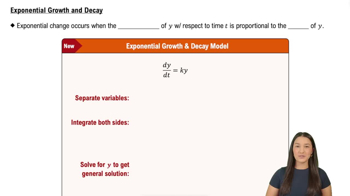
The logistic growth function models population growth with a carrying capacity, expressed as f(P) = rP(1 - P/K), where r is the intrinsic growth rate, P is the population size, and K is the carrying capacity. It describes how growth slows as the population approaches K.
Recommended video:
09:29
Exponential Growth & Decay

Finding Maximum Values Using Derivatives

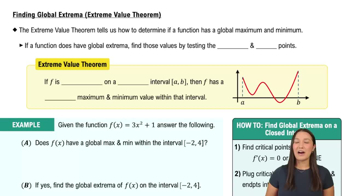
To find the maximum value of a function, take its derivative, set it equal to zero, and solve for critical points. Then, use the second derivative test or analyze the function behavior to confirm if the critical point is a maximum.
Recommended video:
05:12
Finding Global Extrema (Extreme Value Theorem)

Substitution and Evaluation of Functions

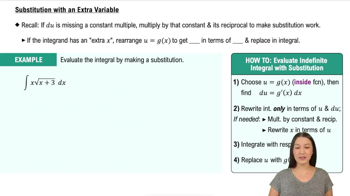
After finding the critical point, substitute it back into the original function to evaluate the maximum value. This step confirms the exact output of the function at the point where the growth rate is maximized.
Recommended video:
04:27
Substitution With an Extra Variable
Related Practice
Textbook Question

A second-order equation Consider the differential equation y''(t) - k²y(t) = 0 where k > 0 is a real number.


a. Verify by substitution that when k = 1, a solution of the equation is y(t) = C₁eᵗ + C₂e⁻ᵗ. You may assume this function is the general solution.

Textbook Question

42–43. Implicit solutions for separable equations For the following separable equations, carry out the indicated analysis.

a. Find the general solution of the equation.


y'(t) = t²/(y² + 1); y(−1) = 1, y(0) = 0, y(−1) = −1


1
views
Textbook Question

27–30. Predator-prey models Consider the following pairs of differential equations that model a predator-prey system with populations x and y. In each case, carry out the following steps.

a. Identify which equation corresponds to the predator and which corresponds to the prey.


x′(t) = −3x + xy, y′(t) = 2y − xy

Textbook Question

23–26. Stirred tank reactions For each of the following stirred tank reactions, carry out the following analysis.

a. Write an initial value problem for the mass of the substance.


A 500-L tank is initially filled with pure water. A copper sulfate solution with a concentration of 20 g/L flows into the tank at a rate of 4 L/min. The thoroughly mixed solution is drained from the tank at a rate of 4 L/min.

Textbook Question

Solving Bernoulli equations Use the method outlined in Exercise 43 to solve the following Bernoulli equations.


a. y′(t) + y = 2y²

1
views
Textbook Question

38–43. Equilibrium solutions A differential equation of the form y′(t)=f(y) is said to be autonomous (the function f depends only on y). The constant function y=y0 is an equilibrium solution of the equation provided f(y0)=0 (because then y'(t)=0 and the solution remains constant for all t). Note that equilibrium solutions correspond to horizontal lines in the direction field. Note also that for autonomous equations, the direction field is independent of t. Carry out the following analysis on the given equations.

a. Find the equilibrium solutions. 


y′(t) = 6 - 2y

1
views