Ch. 9 - Differential Equations
Briggs - Calculus: Early Transcendentals 3rd Edition
Briggs3rd EditionCalculus: Early TranscendentalsISBN: 9780136847243Not the one you use?Change textbook
Chapter 9, Problem 9.3.42a

42–43. Implicit solutions for separable equations For the following separable equations, carry out the indicated analysis.
a. Find the general solution of the equation.


y'(t) = t²/(y² + 1); y(−1) = 1, y(0) = 0, y(−1) = −1


Verified step by step guidance
1
Identify that the given differential equation is separable: \(y'(t) = \frac{t^2}{y^2 + 1}\).
Rewrite the equation in separable form by expressing \(y'\) as \(\frac{dy}{dt}\) and rearranging terms to isolate \(y\) and \(t\): \( (y^2 + 1) dy = t^2 dt\).
Integrate both sides separately: \(\int (y^2 + 1) dy = \int t^2 dt\).
Compute the integrals: The left side becomes \(\int y^2 dy + \int 1 dy = \frac{y^3}{3} + y\), and the right side becomes \(\frac{t^3}{3} + C\), where \(C\) is the constant of integration.
Write the implicit general solution as \(\frac{y^3}{3} + y = \frac{t^3}{3} + C\). Use the initial conditions \(y(-1) = 1\), \(y(0) = 0\), and \(y(-1) = -1\) to solve for the constant \(C\) for each case.

Verified video answer for a similar problem:

This video solution was recommended by our tutors as helpful for the problem above.
Video duration:
1m
Was this helpful?

Key Concepts

Here are the essential concepts you must grasp in order to answer the question correctly.

Separable Differential Equations

A separable differential equation can be written as the product of a function of t and a function of y, allowing the variables to be separated on opposite sides of the equation. This enables integration with respect to each variable independently to find the general solution.
Recommended video:
06:06
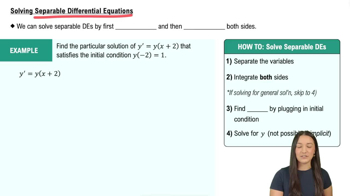
Solving Separable Differential Equations

Implicit Solutions

An implicit solution is a relation involving both variables that satisfies the differential equation but is not explicitly solved for y. Often, after integrating, the solution is given implicitly, requiring further manipulation or interpretation to understand the behavior of y.
Recommended video:
05:14
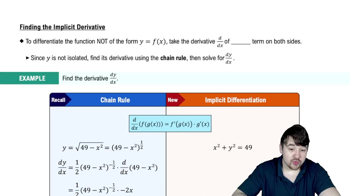
Finding The Implicit Derivative

Initial Conditions and Solution Curves

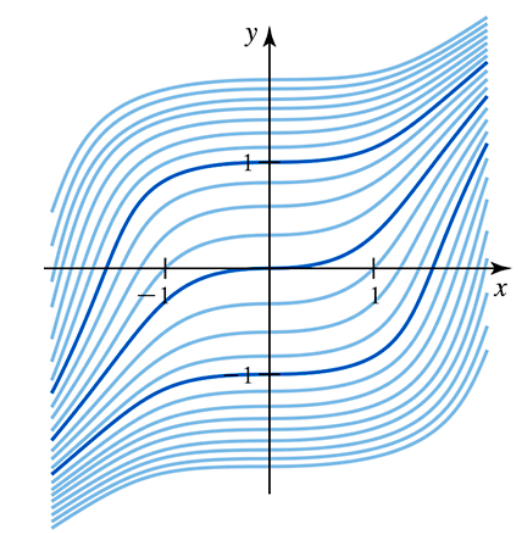
Initial conditions specify particular values of y at given t, allowing determination of the constant of integration and thus a unique solution curve. The direction field or slope field graphically represents these solutions, showing how different initial values lead to different solution trajectories.
Recommended video:
05:03
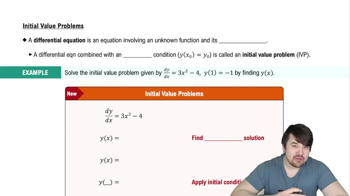
Initial Value Problems
Related Practice
Textbook Question

Growth rate functions

a. Show that the logistic growth rate function f(P)=rP(1−P/K) has a maximum value of rK/4 at the point P=K/2.

Textbook Question

43–44. Motion in a gravitational field: An object is fired vertically upward with initial velocity v(0)=v₀ from initial position s(0)=s₀.

a. For the following values of v₀ and s₀, find the position and velocity functions for all times at which the object is above the ground (s = 0).

v₀ = 49 m/s, s₀ = 60 m

Textbook Question

17–20. Increasing and decreasing solutions Consider the following differential equations. A detailed direction field is not needed.


a. Find the solutions that are constant, for all t ≥ 0 (the equilibrium solutions).


y'(t) = (y−2)(y+1)

1
views
Textbook Question

A second-order equation Consider the differential equation y''(t) - k²y(t) = 0 where k > 0 is a real number.


a. Verify by substitution that when k = 1, a solution of the equation is y(t) = C₁eᵗ + C₂e⁻ᵗ. You may assume this function is the general solution.

Textbook Question

27–30. Predator-prey models Consider the following pairs of differential equations that model a predator-prey system with populations x and y. In each case, carry out the following steps.

a. Identify which equation corresponds to the predator and which corresponds to the prey.


x′(t) = −3x + xy, y′(t) = 2y − xy

Textbook Question

38–43. Equilibrium solutions A differential equation of the form y′(t)=f(y) is said to be autonomous (the function f depends only on y). The constant function y=y0 is an equilibrium solution of the equation provided f(y0)=0 (because then y'(t)=0 and the solution remains constant for all t). Note that equilibrium solutions correspond to horizontal lines in the direction field. Note also that for autonomous equations, the direction field is independent of t. Carry out the following analysis on the given equations.

a. Find the equilibrium solutions. 


y′(t) = 6 - 2y

1
views