
Ch. 9 - Differential Equations
Briggs - Calculus: Early Transcendentals 3rd Edition
Briggs3rd EditionCalculus: Early TranscendentalsISBN: 9780136847243Not the one you use?Change textbook
Chapter 9, Problem 9.1.49a

Explain why or why not Determine whether the following statements are true and give an explanation or counterexample.
a. The general solution of the differential equation y'(t) = 1 is y(t) = t

Verified step by step guidance
1
Identify the given differential equation: \(y'(t) = 1\). This means the derivative of \(y\) with respect to \(t\) is constantly 1.
Recall that the general solution to a differential equation of the form \(y'(t) = c\), where \(c\) is a constant, is \(y(t) = ct + C\), where \(C\) is an arbitrary constant of integration.
Apply this to the given equation: since \(c = 1\), the general solution should be \(y(t) = 1 \cdot t + C\), or simply \(y(t) = t + C\).
Compare this with the proposed solution \(y(t) = t\). Notice that the proposed solution does not include the constant of integration \(C\).
Conclude that the statement is false because the general solution must include the constant \(C\) to account for all possible solutions, not just \(y(t) = t\).

Verified video answer for a similar problem:

This video solution was recommended by our tutors as helpful for the problem above.
Video duration:
1m
Was this helpful?

Key Concepts

Here are the essential concepts you must grasp in order to answer the question correctly.

General Solution of a Differential Equation

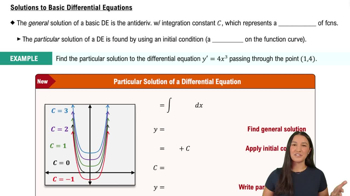
The general solution of a differential equation includes all possible solutions and typically contains an arbitrary constant. It represents a family of functions that satisfy the equation, not just a single function.
Recommended video:
04:00
Solutions to Basic Differential Equations

Integration of Derivatives

To find the general solution of y'(t) = 1, integrate the right-hand side with respect to t. Since the derivative of y is 1, integrating gives y(t) = t + C, where C is an arbitrary constant.
Recommended video:
06:18
Integration by Parts for Definite Integrals

Counterexample and Verification

To verify if a proposed solution is general, check if it includes all solutions. The statement y(t) = t omits the constant C, so it is not the general solution. A counterexample is y(t) = t + 5, which also satisfies y'(t) = 1.
Related Practice
Textbook Question

38–43. Equilibrium solutions A differential equation of the form y′(t)=f(y) is said to be autonomous (the function f depends only on y). The constant function y=y0 is an equilibrium solution of the equation provided f(y0)=0 (because then y'(t)=0 and the solution remains constant for all t). Note that equilibrium solutions correspond to horizontal lines in the direction field. Note also that for autonomous equations, the direction field is independent of t. Carry out the following analysis on the given equations.

a. Find the equilibrium solutions. 


y′(t) = y(y - 3)

Textbook Question

[Use of Tech] Analysis of a separable equation Consider the differential equation yy'(t) = ½eᵗ + t and carry out the following analysis.

a. Find the general solution of the equation and express it explicitly as a function of t in two cases: y > 0 and y < 0.

Textbook Question

Direction field analysis Consider the first-order initial value problem y'(t)=ay+b,y(0)=A for t≥0 where a, b, and A are real numbers.

a. Explain why y=−b/a is an equilibrium solution and corresponds to a horizontal line in the direction field.

Textbook Question

42–43. Implicit solutions for separable equations For the following separable equations, carry out the indicated analysis.

a. Find the general solution of the equation.


e⁻ʸᐟ²y'(x) = 4x sin x² − x; y(0) = 0, y(0) = ln(1/4), y(√(π/2)) = 0


Textbook Question

33–36. {Use of Tech} Computing Euler approximations Use a calculator or computer program to carry out the following steps.

a. Approximate the value of y(T) using Euler’s method with the given time step on the interval [0,T].


y′(t) = -2y, y(0) = 1; Δt = 0.2, T = 2; y(t) = e⁻²ᵗ

1
views
Textbook Question

52-56. In this section, several models are presented and the solution of the associated differential equation is given. Later in the chapter, we present methods for solving these differential equations.


where P(t) is the population, for t ≥ 0, and r > 0 and K > 0 are given constants.


a. Verify by substitution that the general solution of the equation is P(t) = K/(1 + Ce⁻ʳᵗ), where C is an arbitrary constant.