Ch. 9 - Differential Equations
Briggs - Calculus: Early Transcendentals 3rd Edition
Briggs3rd EditionCalculus: Early TranscendentalsISBN: 9780136847243Not the one you use?Change textbook
Chapter 9, Problem 9.3.43a

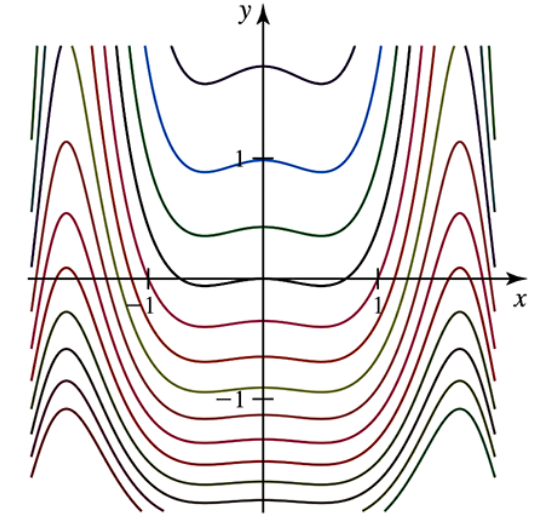
42–43. Implicit solutions for separable equations For the following separable equations, carry out the indicated analysis.
a. Find the general solution of the equation.


e⁻ʸᐟ²y'(x) = 4x sin x² − x; y(0) = 0, y(0) = ln(1/4), y(√(π/2)) = 0


Verified step by step guidance
1
Rewrite the given differential equation \(e^{-\frac{y}{2}} y'(x) = 4x \sin(x^2) - x\) in the form \(\frac{dy}{dx} = e^{\frac{y}{2}} (4x \sin(x^2) - x)\) to isolate \(y'\) on one side.
Recognize that the equation is separable, so rearrange terms to separate variables: \(e^{-\frac{y}{2}} dy = (4x \sin(x^2) - x) dx\).
Integrate both sides: \(\int e^{-\frac{y}{2}} dy = \int (4x \sin(x^2) - x) dx\). For the left side, use substitution \(u = -\frac{y}{2}\); for the right side, split the integral into two parts and use substitution for \(\int 4x \sin(x^2) dx\).
After integrating, include the constant of integration \(C\) and write the implicit general solution relating \(y\) and \(x\).
Use the given initial conditions \(y(0) = 0\), \(y(0) = \ln(\frac{1}{4})\), and \(y(\sqrt{\frac{\pi}{2}}) = 0\) to solve for the constant \(C\) and verify the solution's consistency.

Verified video answer for a similar problem:

This video solution was recommended by our tutors as helpful for the problem above.
Video duration:
7m
Was this helpful?

Key Concepts

Here are the essential concepts you must grasp in order to answer the question correctly.

Separable Differential Equations

A separable differential equation can be written as the product of a function of x and a function of y, allowing the variables to be separated on opposite sides of the equation. This enables integration with respect to each variable independently, facilitating the solution of the differential equation.
Recommended video:
06:06
Solving Separable Differential Equations

Implicit Solutions

An implicit solution to a differential equation is a relation involving both x and y that defines y implicitly as a function of x. Unlike explicit solutions, implicit solutions may not isolate y on one side but still satisfy the differential equation and initial conditions.
Recommended video:
05:14
Finding The Implicit Derivative

Initial Conditions and Particular Solutions

Initial conditions specify the value of the solution at a particular point, allowing determination of the constant of integration in the general solution. Applying these conditions yields a unique particular solution that fits the given problem context.
Recommended video:
05:03
Initial Value Problems
Related Practice
Textbook Question

Explain why or why not Determine whether the following statements are true and give an explanation or counterexample.

a. The general solution of the differential equation y'(t) = 1 is y(t) = t

Textbook Question

[Use of Tech] Analysis of a separable equation Consider the differential equation yy'(t) = ½eᵗ + t and carry out the following analysis.

a. Find the general solution of the equation and express it explicitly as a function of t in two cases: y > 0 and y < 0.

Textbook Question

{Use of Tech} Torricelli’s law An open cylindrical tank initially filled with water drains through a hole in the bottom of the tank according to Torricelli’s law (see figure). If h(t) is the depth of water in the tank for t≥0 s, then Torricelli’s law implies h′(t)=−k√h, where k is a constant that includes g=9.8m/s², the radius of the tank, and the radius of the drain. Assume the initial depth of the water is h(0)=Hm. 

a. Find the solution of the initial value problem.

1
views
Textbook Question

Cooling time Suppose an object with an initial temperature of T₀ > 0 is put in surroundings with an ambient temperature of A, where A < T₀/2. Let t₁/₂ be the time required for the object to cool to T₀/2.


a. Show that t₁/₂ = −1/k ln((T₀ − 2A)/(2(T₀ − A))).

Textbook Question

52-56. In this section, several models are presented and the solution of the associated differential equation is given. Later in the chapter, we present methods for solving these differential equations.


where P(t) is the population, for t ≥ 0, and r > 0 and K > 0 are given constants.


a. Verify by substitution that the general solution of the equation is P(t) = K/(1 + Ce⁻ʳᵗ), where C is an arbitrary constant.

Textbook Question

Stirred tank reaction A 100-L tank is filled with pure water when an inflow pipe is opened and a sugar solution with a concentration of 20 gm/L flows into the tank at a rate of 0.5 L/min. The solution is thoroughly mixed and flows out of the tank at a rate of 0.5 L/min.


c. At what time does the mass of sugar reach 95% of its steady-state level?

1
views