Ch. 9 - Differential Equations
Briggs - Calculus: Early Transcendentals 3rd Edition
Briggs3rd EditionCalculus: Early TranscendentalsISBN: 9780136847243Not the one you use?Change textbook
Chapter 9, Problem 9.1.33

33–42. Solving initial value problems Solve the following initial value problems.
y'(t) = 1 + eᵗ, y(0) = 4

Verified step by step guidance
1
Identify the given differential equation and initial condition: \(y'(t) = 1 + e^{t}\) with \(y(0) = 4\).
Recognize that this is a first-order ordinary differential equation where \(y'(t)\) is given explicitly, so you can find \(y(t)\) by integrating the right-hand side with respect to \(t\).
Set up the integral to find \(y(t)\): \(y(t) = \int (1 + e^{t}) \, dt + C\), where \(C\) is the constant of integration.
Compute the integral: \(\int 1 \, dt = t\) and \(\int e^{t} \, dt = e^{t}\), so \(y(t) = t + e^{t} + C\).
Use the initial condition \(y(0) = 4\) to solve for \(C\): substitute \(t=0\) into \(y(t)\) to get \(4 = 0 + e^{0} + C\), then solve for \(C\).

Verified video answer for a similar problem:

This video solution was recommended by our tutors as helpful for the problem above.
Video duration:
2m
Was this helpful?

Key Concepts

Here are the essential concepts you must grasp in order to answer the question correctly.

Initial Value Problems (IVPs)

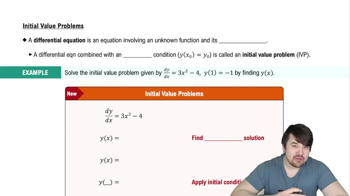
An initial value problem involves finding a function that satisfies a differential equation and meets a specified initial condition, such as y(0) = 4. This condition helps determine the unique solution among infinitely many possible solutions.
Recommended video:
05:03
Initial Value Problems

Solving First-Order Differential Equations

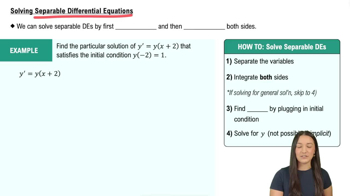
A first-order differential equation relates a function and its first derivative. Solving it often involves integrating the derivative expression to find the original function, plus a constant of integration determined by the initial condition.
Recommended video:
06:06
Solving Separable Differential Equations

Integration of Exponential Functions

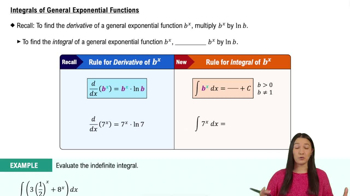
Integrating expressions involving exponential functions like e^t requires applying the rule that the integral of e^t with respect to t is e^t plus a constant. This is essential for solving the given differential equation y'(t) = 1 + e^t.
Recommended video:
05:11
Integrals of General Exponential Functions
Related Practice
Textbook Question

17–32. Solving initial value problems Determine whether the following equations are separable. If so, solve the initial value problem.

y'(t) = cos² y, y(1) = π/4

Textbook Question

What is a separable first-order differential equation?

Textbook Question

9–14. Growth rate functions Make a sketch of the population function P (as a function of time) that results from the following growth rate functions. Assume the population at time t = 0 begins at some positive value.


Textbook Question

23–26. Loan problems The following initial value problems model the payoff of a loan. In each case, solve the initial value problem, for t≥0 graph the solution, and determine the first month in which the loan balance is zero.


B′(t) = 0.005B − 500, B(0) = 50,000

Textbook Question

9–14. Growth rate functions Make a sketch of the population function P (as a function of time) that results from the following growth rate functions. Assume the population at time t = 0 begins at some positive value.


Textbook Question

39–42. Special equations A special class of first-order linear equations have the form a(t)y'(t)+a'(t)y(t)=f(t), where a and f are given functions of t. Notice that the left side of this equation can be written as the derivative of a product, so the equation has the form

a(t)y'(t) + a'(t)y(t) = d/dt (a(t)y(t)) = f(t). 

Therefore, the equation can be solved by integrating both sides with respect to t. Use this idea to solve the following initial value problems. 


t³y′(t) + 3t²y = (1 + t)/t, y(1) = 6

1
views