Ch. 9 - Differential Equations
Briggs - Calculus: Early Transcendentals 3rd Edition
Briggs3rd EditionCalculus: Early TranscendentalsISBN: 9780136847243Not the one you use?Change textbook
Chapter 9, Problem 9.4.30

27–30. Newton’s Law of Cooling Solve the differential equation for Newton’s Law of Cooling to find the temperature function in the following cases. Then answer any additional questions.


A pot of boiling soup (100°C) is put in a cellar with a temperature of 10°C. After 30 minutes, the soup has cooled to 80°C. When will the temperature of the soup reach 30°C 

Verified step by step guidance
1
Identify the variables and constants in Newton's Law of Cooling. Let \(T(t)\) be the temperature of the soup at time \(t\) (in minutes), \(T_a\) be the ambient temperature (10°C), and \(T_0\) be the initial temperature of the soup (100°C).
Write the differential equation representing Newton's Law of Cooling: \(\frac{dT}{dt} = -k (T - T_a)\), where \(k\) is a positive constant representing the cooling rate.
Solve the differential equation by separating variables or using an integrating factor. The general solution has the form: \(T(t) = T_a + (T_0 - T_a) e^{-k t}\).
Use the given information that after 30 minutes, the temperature is 80°C to find the constant \(k\). Substitute \(t=30\), \(T(30) = 80\), \(T_a = 10\), and \(T_0 = 100\) into the solution and solve for \(k\).
Once \(k\) is found, set \(T(t) = 30\) and solve for \(t\) to find when the soup reaches 30°C.

Verified video answer for a similar problem:

This video solution was recommended by our tutors as helpful for the problem above.
Video duration:
6m
Was this helpful?

Key Concepts

Here are the essential concepts you must grasp in order to answer the question correctly.

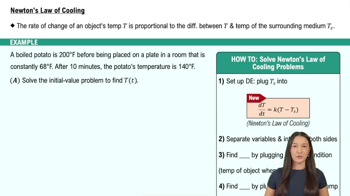
Newton’s Law of Cooling

Newton’s Law of Cooling states that the rate of change of an object's temperature is proportional to the difference between its temperature and the ambient temperature. Mathematically, it is expressed as a first-order differential equation, which models how the temperature approaches the surrounding temperature over time.
Recommended video:
10:44
Newton's Law of Cooling

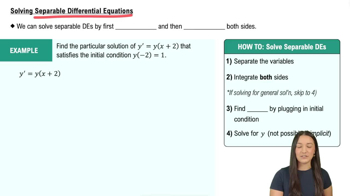
Solving First-Order Differential Equations

To find the temperature function, you solve the first-order linear differential equation derived from Newton’s Law of Cooling. This involves separating variables or using an integrating factor to obtain a general solution that describes temperature as a function of time.
Recommended video:
06:06
Solving Separable Differential Equations

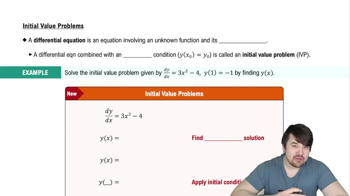
Applying Initial Conditions and Solving for Time

After finding the general temperature function, initial conditions like the starting temperature and temperature at a specific time are used to determine constants. Then, to find when the temperature reaches a certain value, you solve the equation for time by substituting the target temperature.
Recommended video:
05:03
Initial Value Problems
Related Practice
Textbook Question

21–32. Finding general solutions Find the general solution of each differential equation. Use C,C1,C2... to denote arbitrary constants.

p'(x) = 16/x⁹ - 5 + 14x⁶

1
views

Textbook Question

15–16. {Use of Tech} Solving logistic equations Write a logistic equation with the following parameter values. Then solve the initial value problem and graph the solution. Let r be the natural growth rate, K the carrying capacity, and P₀ the initial population.


r=0.2, K=300, P₀=50

Textbook Question

Stability of Euler's method Consider the initial value problem y′(t) = −ay, y(0) = 1 where a > 0; it has the exact solution y(t) = e⁻ᵃᵗ, which is a decreasing function.


a. Show that Euler's method applied to this problem with time step h can be written u₀ = 1, uₖ₊₁ = (1 − ah)uₖ for k = 0, 1, 2, ...


b. Show by substitution that uₖ = (1 − ah)ᵏ is a solution of the equations in part (a), for k = 0, 1, 2, ...

1
views
Textbook Question

Explain how to solve a separable differential equation of the form

g(t)y'(y) = h(t)

1
views
Textbook Question

27–30. Newton’s Law of Cooling Solve the differential equation for Newton’s Law of Cooling to find the temperature function in the following cases. Then answer any additional questions.


An iron rod is removed from a blacksmith’s forge at a temperature of 900°C . Assume k=0.02 and the rod cools in a room with a temperature of 30°C When does the temperature of the rod reach 100°C? 

1
views
Textbook Question

5–16. Solving separable equations Find the general solution of the following equations. Express the solution explicitly as a function of the independent variable.

e⁴ᵗy'(t) = 5

1
views