
Textbook Question
21–32. Finding general solutions Find the general solution of each differential equation. Use C,C1,C2... to denote arbitrary constants.
p'(x) = 16/x⁹ - 5 + 14x⁶
1
views

 Verified step by step guidance
 10:44
10:44
 06:06
06:06 09:29
09:2921–32. Finding general solutions Find the general solution of each differential equation. Use C,C1,C2... to denote arbitrary constants.
p'(x) = 16/x⁹ - 5 + 14x⁶
27–30. Newton’s Law of Cooling Solve the differential equation for Newton’s Law of Cooling to find the temperature function in the following cases. Then answer any additional questions.
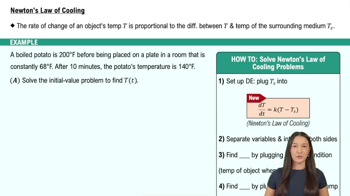
A pot of boiling soup (100°C) is put in a cellar with a temperature of 10°C. After 30 minutes, the soup has cooled to 80°C. When will the temperature of the soup reach 30°C
15–16. {Use of Tech} Solving logistic equations Write a logistic equation with the following parameter values. Then solve the initial value problem and graph the solution. Let r be the natural growth rate, K the carrying capacity, and P₀ the initial population.
r=0.2, K=300, P₀=50
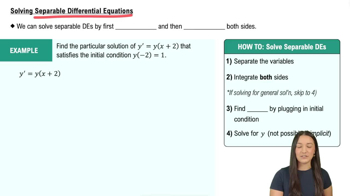
5–16. Solving separable equations Find the general solution of the following equations. Express the solution explicitly as a function of the independent variable.
(t² + 1)³yy'(t) = t(y² + 4)
Explain how to solve a separable differential equation of the form
g(t)y'(y) = h(t)
5–16. Solving separable equations Find the general solution of the following equations. Express the solution explicitly as a function of the independent variable.
e⁴ᵗy'(t) = 5