
Ch. 9 - Differential Equations
Briggs - Calculus: Early Transcendentals 3rd Edition
Briggs3rd EditionCalculus: Early TranscendentalsISBN: 9780136847243Not the one you use?Change textbook
Chapter 9, Problem 9.5.23b

23–26. Stirred tank reactions For each of the following stirred tank reactions, carry out the following analysis.
b. Solve the initial value problem.


A 500-L tank is initially filled with pure water. A copper sulfate solution with a concentration of 20 g/L flows into the tank at a rate of 4 L/min. The thoroughly mixed solution is drained from the tank at a rate of 4 L/min.

Verified step by step guidance
1
Identify the variable to describe the system. Let \(Q(t)\) represent the amount of copper sulfate (in grams) in the tank at time \(t\) (in minutes).
Set up the differential equation based on the rate of change of \(Q(t)\). The rate of change equals the rate in minus the rate out:
\[ \frac{dQ}{dt} = \text{(rate in)} - \text{(rate out)} \]
Calculate the rate in: The inflow concentration is 20 g/L and the inflow rate is 4 L/min, so the rate in is \(4 \times 20 = 80\) g/min.
Calculate the rate out: The outflow rate is 4 L/min, and the concentration in the tank at time \(t\) is \(\frac{Q(t)}{500}\) g/L (since the tank volume is constant at 500 L). Thus, the rate out is \(4 \times \frac{Q(t)}{500} = \frac{4}{500} Q(t)\) g/min.
Write the initial value problem (IVP) combining these expressions:
\[ \frac{dQ}{dt} = 80 - \frac{4}{500} Q(t), \quad Q(0) = 0 \]
This is a first-order linear ordinary differential equation. To solve it, use an integrating factor or recognize it as a separable equation.

Verified video answer for a similar problem:

This video solution was recommended by our tutors as helpful for the problem above.
Video duration:
5m
Was this helpful?

Key Concepts

Here are the essential concepts you must grasp in order to answer the question correctly.

Formulating the Initial Value Problem (IVP)

An initial value problem involves a differential equation along with a specified initial condition. In this context, it models the rate of change of copper sulfate concentration in the tank over time, starting from an initial state of pure water (zero concentration). Setting up the IVP requires expressing the inflow, outflow, and accumulation of the substance mathematically.
Recommended video:
05:03
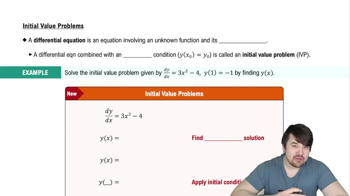
Initial Value Problems

Mass Balance and Rate of Change

Mass balance principles state that the rate of change of the substance in the tank equals the rate in minus the rate out. Here, the inflow concentration and flow rate add copper sulfate, while the outflow removes it at the current tank concentration. This balance leads to a first-order linear differential equation describing the system.
Recommended video:
04:16
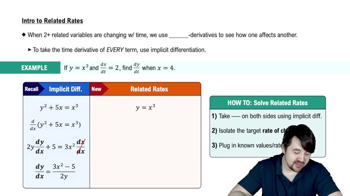
Intro To Related Rates

Solving First-Order Linear Differential Equations

The differential equation derived is typically linear and separable or solvable using integrating factors. Solving it yields the concentration as a function of time, satisfying the initial condition. Understanding solution methods for such equations is essential to find the explicit concentration profile in the tank.
Recommended video:
06:06
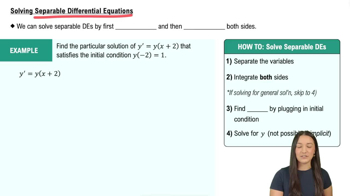
Solving Separable Differential Equations
Related Practice
Textbook Question

Explain why or why not Determine whether the following statements are true and give an explanation or counterexample.

b. The general solution of the separable equation y'(t) = t/(y' + 10y⁴) can be expressed explicitly with y in terms of t.

1
views
Textbook Question

52-56. In this section, several models are presented and the solution of the associated differential equation is given. Later in the chapter, we present methods for solving these differential equations.


{Use of Tech} Tumor growth The growth of cancer tumors may be modeled by the Gompertz growth equation. Let M(t) be the mass of a tumor, for t ≥ 0. The relevant initial value problem is:


dM/dt = -rM(t)ln(M(t)/K), M(0) = M₀,


where r and K are positive constants and 0 < M₀ < K.


b. Graph the solution for M₀ = 100 and r = 0.05.

Textbook Question

27–30. Predator-prey models Consider the following pairs of differential equations that model a predator-prey system with populations x and y. In each case, carry out the following steps.

b. Find the lines along which x'(t) = 0. Find the lines along which y'(t) = 0.


x′(t) = 2x − 4xy, y′(t) = −y + 2xy

1
views
Textbook Question

17–20. Increasing and decreasing solutions Consider the following differential equations. A detailed direction field is not needed.


b. In what regions are solutions increasing? Decreasing?


y'(t) = (y−1)(1+y)

1
views
Textbook Question

23–26. Stirred tank reactions For each of the following stirred tank reactions, carry out the following analysis.

b. Solve the initial value problem.


A one-million-liter pond is contaminated by a chemical pollutant with a concentration of 20 g/L. The source of the pollutant is removed, and pure water is allowed to flow into the pond at a rate of 1200 L/hr. Assuming the pond is thoroughly mixed and drained at a rate of 1200 L/hr, how long does it take to reduce the concentration of the solution in the pond to 10% of the initial value?

Textbook Question

17–20. Increasing and decreasing solutions Consider the following differential equations. A detailed direction field is not needed.


b. In what regions are solutions increasing? Decreasing?


y'(t) = y(y+3)(4-y)

1
views