
Ch. 9 - Differential Equations
Briggs - Calculus: Early Transcendentals 3rd Edition
Briggs3rd EditionCalculus: Early TranscendentalsISBN: 9780136847243Not the one you use?Change textbook
Chapter 9, Problem 9.2.17b

17–20. Increasing and decreasing solutions Consider the following differential equations. A detailed direction field is not needed.


b. In what regions are solutions increasing? Decreasing?


y'(t) = (y−1)(1+y)

Verified step by step guidance
1
Identify the differential equation given: \(y'(t) = (y - 1)(1 + y)\).
Determine where the derivative \(y'(t)\) is positive or negative by analyzing the sign of each factor: \((y - 1)\) and \((1 + y)\).
Find the critical points where \(y'(t) = 0\), which occur when either \((y - 1) = 0\) or \((1 + y) = 0\). These points are \(y = 1\) and \(y = -1\).
Divide the \(y\)-axis into intervals based on these critical points: \((-\infty, -1)\), \((-1, 1)\), and \((1, \infty)\).
Test the sign of \(y'(t)\) in each interval by choosing a test value from each interval and substituting it into \(y'(t) = (y - 1)(1 + y)\) to determine where the solutions are increasing (\(y'(t) > 0\)) or decreasing (\(y'(t) < 0\)).

Verified video answer for a similar problem:

This video solution was recommended by our tutors as helpful for the problem above.
Video duration:
2m
Was this helpful?

Key Concepts

Here are the essential concepts you must grasp in order to answer the question correctly.

Differential Equations and Their Solutions

A differential equation relates a function to its derivatives, describing how the function changes. Solutions to differential equations are functions that satisfy this relationship. Understanding the behavior of solutions, such as whether they increase or decrease, involves analyzing the sign of the derivative.
Recommended video:
04:00
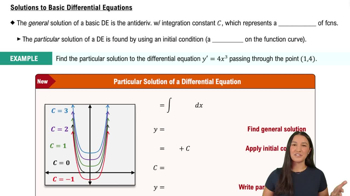
Solutions to Basic Differential Equations

Sign of the Derivative and Monotonicity

The sign of the derivative y'(t) determines whether the solution y(t) is increasing or decreasing. If y'(t) > 0, the function is increasing; if y'(t) < 0, it is decreasing. Identifying intervals where the derivative changes sign helps locate regions of increase or decrease.
Recommended video:
05:44
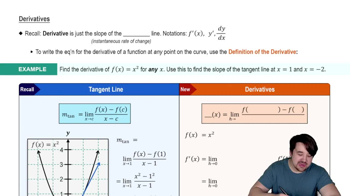
Derivatives

Critical Points and Equilibrium Solutions

Critical points occur where y'(t) = 0, indicating potential equilibrium solutions where the function remains constant. For y'(t) = (y−1)(1+y), the critical points are y = 1 and y = -1. These points divide the y-axis into regions that determine the behavior of solutions around them.
Recommended video:
04:50
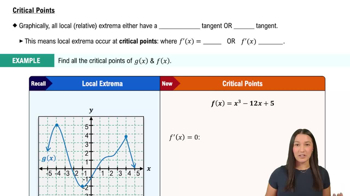
Critical Points
Related Practice
Textbook Question

33–36. {Use of Tech} Computing Euler approximations Use a calculator or computer program to carry out the following steps.

b. Using the exact solution (also given), find the error in the approximation to y(T) (only at the right endpoint of the time interval).


y′(t) = -2y, y(0) = 1; Δt = 0.2, T = 2; y(t) = e⁻²ᵗ

2
views
Textbook Question

23–26. Stirred tank reactions For each of the following stirred tank reactions, carry out the following analysis.

b. Solve the initial value problem.


A 500-L tank is initially filled with pure water. A copper sulfate solution with a concentration of 20 g/L flows into the tank at a rate of 4 L/min. The thoroughly mixed solution is drained from the tank at a rate of 4 L/min.

Textbook Question

27–30. Predator-prey models Consider the following pairs of differential equations that model a predator-prey system with populations x and y. In each case, carry out the following steps.

b. Find the lines along which x'(t) = 0. Find the lines along which y'(t) = 0.


x′(t) = 2x − 4xy, y′(t) = −y + 2xy

1
views
Textbook Question

Properties of stirred tank solutions


b. Verify that M(0) = M₀

Textbook Question

23–26. Stirred tank reactions For each of the following stirred tank reactions, carry out the following analysis.

b. Solve the initial value problem.


A one-million-liter pond is contaminated by a chemical pollutant with a concentration of 20 g/L. The source of the pollutant is removed, and pure water is allowed to flow into the pond at a rate of 1200 L/hr. Assuming the pond is thoroughly mixed and drained at a rate of 1200 L/hr, how long does it take to reduce the concentration of the solution in the pond to 10% of the initial value?

Textbook Question

brOrthogonal trajectories Two curves are orthogonal to each other if their tangent lines are perpendicular at each point of intersection. A family of curves forms orthogonal trajectories with another family of curves if each curve in one family is orthogonal to each curve in the other family. Use the following steps to find the orthogonal trajectories of the family of ellipses 2x² + y² = a²


b. The family of trajectories orthogonal to 2x² + y² = a² satisfies the differential equation dy/dx = y/(2x). Why?

1
views