Back
Back
Problem 8.2.26
9–40. Integration by parts Evaluate the following integrals using integration by parts.
26. ∫ t³ sin(t) dt
Problem 8.4.71
{Use of Tech} Using the integral of sec³u By reduction formula 4 in Section 8.3,
∫sec³u du = 1/2 (sec u tan u + ln |sec u + tan u|) + C
Graph the following functions and find the area under the curve on the given interval.
f(x) = (9 - x²) ⁻², [0, 3/2]
Problem 8.7.42
41–48. Geometry problems Use a table of integrals to solve the following problems.
42. Find the length of the curve y = x^(3/2) + 8 on the interval from 0 to 2.
Problem 8.6.2
Choosing an integration strategy Identify a technique of integration for evaluating the following integrals. If necessary, explain how to first simplify the integrand before applying the suggested technique of integration. You do not need to evaluate the integrals.
∫ (1 + tan x) sec²x dx
Problem 8.9.44
7–58. Improper integrals Evaluate the following integrals or state that they diverge.
44. ∫ (from 0 to ln 3) eʸ/(eʸ-1)⁷ᐟ³ dy
Problem 8.4.83
Visual proof Let F(x)=∫₀ˣ √(a²−t²) dt. The figure shows that F(x)= area of sector OAB+ area of triangle OBC.
a. Use the figure to prove that
F(x) = (a² sin ⁻¹(x/a))/2 + x√(a²−x²)/2
b. Conclude that ∫ √(a²−x²) dx = (a² sin ⁻¹(x/a))/2 + x√(a²−x²)/2 + C.
Problem 8.1.57
7–64. Integration review Evaluate the following integrals.
57. ∫ dx / (x¹⸍² + x³⸍²)
Problem 8.5.32
23-64. Integration Evaluate the following integrals.
32. ∫ (4x - 2)/(x³ - x) dx
Problem 8.9.96
95–98. {Use of Tech} Numerical methods Use numerical methods or a calculator to approximate the following integrals as closely as possible. The exact value of each integral is given.
96. ∫(from 0 to ∞) (sin²x)/x² dx = π/2
Problem 8.5.88
87-92. An integrand with trigonometric functions in the numerator and denominator can often be converted to a rational function using the substitution u = tan(x/2) or, equivalently, x = 2 tan⁻¹u. The following relations are used in making this change of variables.
A: dx = 2/(1 + u²) du
B: sin x = 2u/(1 + u²)
C: cos x = (1 - u²)/(1 + u²)
88. Evaluate ∫ dx/(2 + cos x).
Problem 8.1.8
7–64. Integration review Evaluate the following integrals.
8. ∫ (9x - 2)^(-3) dx
Problem 8.1.69
69. Different substitutions
b. Evaluate ∫(tan x sec² x) dx using the substitution u=secx.
Problem 8.6.27
7–84. Evaluate the following integrals.
27. ∫ sin⁴(x/2) dx
Problem 8.2.48
48. Integral of sec³x Use integration by parts to show that:
∫ sec³x dx = (1/2) secx tanx + (1/2) ∫ secx dx
Problem 8.8.57
54–57. {Use of Tech} Comparing the Midpoint and Trapezoid Rules Compare the errors in the Midpoint and Trapezoid Rules with n = 4, 8, 16, and 32 subintervals when they are applied to the following integrals (with their exact values given).
59. ∫(from 0 to π) ln(5 + 3cosx) dx = π ln(9/2)
Problem 8.3.47
9–61. Trigonometric integrals Evaluate the following integrals.
47. ∫ (csc⁴x)/(cot²x) dx
Problem 8.5.9
5–16. Set up the appropriate form of the partial fraction decomposition for the following expressions. Do not find the values of the unknown constants.
9. 4/(x⁵ - 5x³ + 4x)
Problem 8.8.38
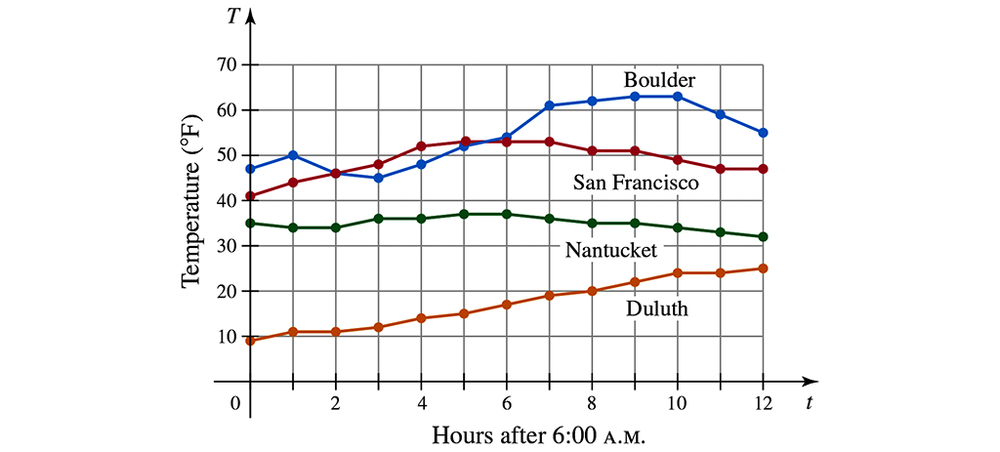
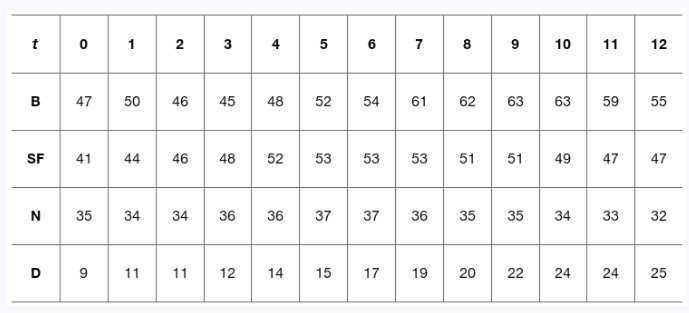
37-40. {Use of Tech} Temperature data
Howdy temperature data for Boulder, Colorado; San Francisco, California; Nantucket, Massachusetts; and Duluth, Minnesota, over a 12-hr period on the same day of January are shown in the figure.
Assume these data are taken from a continuous temperature function T(t). The average temperature (in °F) over the 12-hr period is:
T_avg = (1/12) × ∫(0 to 12) T(t) dt
38. Find an accurate approximation to the average temperature over the 12-hr period for San Francisco. State your method.
Problem 8.9.22
7–58. Improper integrals Evaluate the following integrals or state that they diverge.
22. ∫ (from -∞ to -2) (1/x²) sin(π/2) dx
Problem 8.7.67
65-68. Reduction formulas Use the reduction formulas in a table of integrals to evaluate the following integrals.
67. ∫tan⁴(3y) dy
Problem 8.5.85
85. Another form of ∫ sec x dx
a. Verify the identity:
sec x = cos x / (1 - sin² x)
b. Use the identity in part (a) to verify that:
∫ sec x dx = (1/2) ln |(1 + sin x)/(1 - sin x)| + C
Problem 8.1.53
7–64. Integration review Evaluate the following integrals.
53. ∫ eˣ sec(eˣ + 1) dx
Problem 8.7.11
7–40. Table look-up integrals Use a table of integrals to evaluate the following indefinite integrals. Some of the integrals require preliminary work, such as completing the square or changing variables, before they can be found in a table.
11. ∫ 3u / (2u + 7) du
Problem 8.2.7
Use a substitution to reduce the following integrals to ∫ ln u du. Then evaluate using the formula for ∫ ln x dx.
7. ∫ (sec²x) · ln(tan x + 2) dx
Problem 8.8.64
64. (Use of Tech) Normal distribution of movie lengths
A study revealed that the lengths of U.S. movies are normally distributed with a mean of 110 minutes and a standard deviation of 22 minutes. This means that the fraction of movies with lengths between a and b minutes (with a < b) is given by the integral:
(1/(22√(2π))) ∫[a to b] e^(-((x-110)/22)²/2) dx.
What percentage of U.S. movies are between 1 hr and 1.5 hr long (60-90 min)?
Problem 8.5.54
23-64. Integration Evaluate the following integrals.
54. ∫ (z + 1)/[z(z² + 4)] dz
Problem 8.2.51
50-53. Reduction Formulas Use integration by parts to derive the following reduction formulas:
51. ∫ xⁿ cos(ax) dx = (xⁿ sin(ax))/a - (n/a) ∫ xⁿ⁻¹ sin(ax) dx, for a ≠ 0
Problem 8.3.57
9–61. Trigonometric integrals Evaluate the following integrals.
57. ∫ from 0 to π of (1 - cos2x)³ᐟ² dx
Problem 8.3.45
9–61. Trigonometric integrals Evaluate the following integrals.
45. ∫ sec²x tan¹ᐟ²x dx
Problem 8.6.74
Evaluate the following integrals.
∫ e³ˣ/(eˣ - 1) dx