Back
Back
Problem 8.R.15
2–74. Integration techniques Use the methods introduced in Sections 8.1 through 8.5 to evaluate the following integrals.
15. ∫ (from 1 to 2) (3x⁵ + 48x³ + 3x² + 16)/(x³ + 16x) dx
Problem 8.R.46
2–74. Integration techniques Use the methods introduced in Sections 8.1 through 8.5 to evaluate the following integrals.
46. ∫ (x³ + 4x² + 12x + 4)/((x² + 4x + 10)²) dx
Problem 8.R.60
2–74. Integration techniques Use the methods introduced in Sections 8.1 through 8.5 to evaluate the following integrals.
60. ∫ x² coshx dx
Problem 8.R.9
2–74. Integration techniques Use the methods introduced in Sections 8.1 through 8.5 to evaluate the following integrals.
9. ∫ (from 0 to π/4) cos⁵ 2x sin² 2x dx
Problem 8.R.106
106. Arc length Find the length of the curve y = (x / 2) * sqrt(3 - x^2) + (3 / 2) * sin^(-1)(x / sqrt(3)) from x = 0 to x = 1.
Problem 8.R.84
82-88. Improper integrals Evaluate the following integrals or show that the integral diverges.
84. ∫ (from 0 to π) sec²x dx*(Note: Potential improperness at x = π/2)*
Problem 8.R.118b
118. Two worthy integrals
b. Let f be any positive continuous function on the interval [0, π/2]. Evaluate
∫ from 0 to π/2 of [f(cos x) / (f(cos x) + f(sin x))] dx.
(Hint: Use the identity cos(π/2 − x) = sin x.)
(Source: Mathematics Magazine 81, 2, Apr 2008)
Problem 8.R.74
2–74. Integration techniques Use the methods introduced in Sections 8.1 through 8.5 to evaluate the following integrals.
74. ∫ dx/√(√(1 + √x))
Problem 8.R.120
120. Equal volumes
a. Let R be the region bounded by the graph of f(x) = x^(-p) and the x-axis, for x ≥ 1. Let V₁ and V₂ be the volumes of the solids generated when R is revolved about the x-axis and the y-axis, respectively, if they exist. For what values of p (if any) is V₁ = V₂?
b. Repeat part (a) on the interval [0, 1].
Problem 8.R.54
2–74. Integration techniques Use the methods introduced in Sections 8.1 through 8.5 to evaluate the following integrals.
54. ∫ dx/√(9x² - 25), x > 5/3
Problem 8.R.119b
119. {Use of Tech} Comparing volumes Let R be the region bounded by y = ln(x), the x-axis, and the line x = a, where a > 1.
b. Find the volume V₂(a) of the solid generated when R is revolved about the y-axis (as a function of a).
Problem 8.RE.22
2–74. Integration techniques Use the methods introduced in Sections 8.1 through 8.5 to evaluate the following integrals.
22. ∫ tan³ 5θ dθ
Problem 8.RE.48
2–74. Integration techniques Use the methods introduced in Sections 8.1 through 8.5 to evaluate the following integrals.
48. ∫ sin(3x) cos⁶(3x) dx
Problem 8.RE.32
2–74. Integration techniques Use the methods introduced in Sections 8.1 through 8.5 to evaluate the following integrals.
32. ∫ csc²(6x) cot(6x) dx
Problem 8.RE.6
2–74. Integration techniques Use the methods introduced in Sections 8.1 through 8.5 to evaluate the following integrals.
6. ∫ (2 − sin 2θ)/cos² 2θ dθ
Problem 8.RE.29
2–74. Integration techniques Use the methods introduced in Sections 8.1 through 8.5 to evaluate the following integrals.
29. ∫ cos⁴ x/sin⁶ x dx
Problem 8.RE.51
2–74. Integration techniques Use the methods introduced in Sections 8.1 through 8.5 to evaluate the following integrals.
51. ∫ (from 0 to π/4) sin⁵(4θ) dθ
Problem 8.7.86a
Arc length of a parabola Let L(c) be the length of the parabola f(x) = x² from x = 0 to x = c, where c ≥ 0 is a constant.
a. Find an expression for L.
Problem 8.2.60a
60. Two Methods
a. Evaluate ∫(x · ln(x²)) dx using the substitution u = x² and evaluating ∫(ln(u)) du.
Problem 8.8.70a
66–71. {Use of Tech} Estimating error Refer to Theorem 8.1 in the following exercises.
70. Let f(x) = e^(-x²).
a. Find a Simpson's Rule approximation to the integral from 0 to 3 of e^(-x²) dx using n = 30 subintervals.
Problem 8.8.41a
41-44. {Use of Tech} Nonuniform grids
Use the indicated methods to solve the following problems with nonuniform grids.
41. A curling iron is plugged into an outlet at time t = 0. Its temperature T in degrees Fahrenheit, assumed to be a continuous function that is strictly increasing and concave down on 0 ≤ t ≤ 120, is given at various times (in seconds) in the table.
a. Approximate (1/120)∫(0 to 120)T(t)dt in three ways using a left Riemann sum, using a right Riemann sum and using the Trapezoid Rule
Interpret the value of (1/120)∫(0 to 120)T(t)dt in the context of this problem.
Problem 8.8.69a
66–71. {Use of Tech} Estimating error Refer to Theorem 8.1 in the following exercises.
69. Let f(x) = sin(eˣ).
a. Find a Trapezoid Rule approximation to ∫[0 to 1] sin(eˣ) dx using n = 40 subintervals.
Problem 8.4.57a
57. Explain why or why not Determine whether the following statements are true and give an explanation or counterexample.
a. If x = 4 tanθ, then cscθ = 4/x.
Problem 8.8.42a
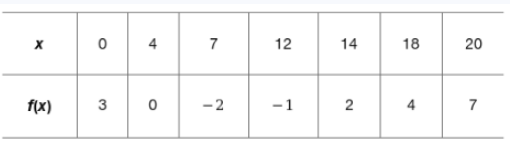
42. Approximating integrals The function f is twice differentiable on (-∞, ∞). Values of f at various points on [0, 20] are given in the table.
a. Approximate ∫(0 to 120) f(x) dx in three way using a left Riemann sum, a right Riemann sum and the Trapezoid Rule
Problem 8.2.81a
81. Possible and impossible integrals
Let Iₙ = ∫ xⁿ e⁻ˣ² dx, where n is a nonnegative integer.
a. I₀ = ∫ e⁻ˣ² dx cannot be expressed in terms of elementary functions. Evaluate I₁.
Problem 8.8.53a
Explain why or why not Determine whether the following statements are true and give an explanation or counterexample.
a. Suppose ∫_a^b f(x) dx is approximated with Simpson’s Rule using n = 18 subintervals, where |f^(4)(x)| ≤ 1 on [a, b]. The absolute error E_S in approximating the integral satisfies E_S ≤ (Δx)^5 / 10.
Problem 8.8.67a
66–71. {Use of Tech} Estimating error Refer to Theorem 8.1 in the following exercises.
67. Let f(x) = √(x³ + 1).
a. Find a Midpoint Rule approximation to ∫[1 to 6] √(x³ + 1) dx using n = 50 subintervals.
Problem 8.9.111a
Gamma function The gamma function is defined by Γ(p) = ∫ from 0 to ∞ of x^(p-1) e^(-x) dx, for p not equal to zero or a negative integer.
a. Use the reduction formula ∫ from 0 to ∞ of x^p e^(-x) dx = p ∫ from 0 to ∞ of x^(p-1) e^(-x) dx for p = 1, 2, 3, ...
to show that Γ(p + 1) = p! (p factorial).
Problem 8.8.68a
66–71. {Use of Tech} Estimating error Refer to Theorem 8.1 in the following exercises.
68. Let f(x) = e^(x²).
a. Find a Trapezoid Rule approximation to ∫[0 to 1] e^(x²) dx using n = 50 subintervals.
Problem 8.6.85a
85. Explain why or why not Determine whether the following statements are true and give an explanation or counterexample.
a. More than one integration method can be used to evaluate ∫ (1 / (1 - x²)) dx.