Ch. 8 - Integration Techniques
Briggs - Calculus: Early Transcendentals 3rd Edition
Briggs3rd EditionCalculus: Early TranscendentalsISBN: 9780136847243Not the one you use?Change textbook
Chapter 8, Problem 8.8.36

River flow rates
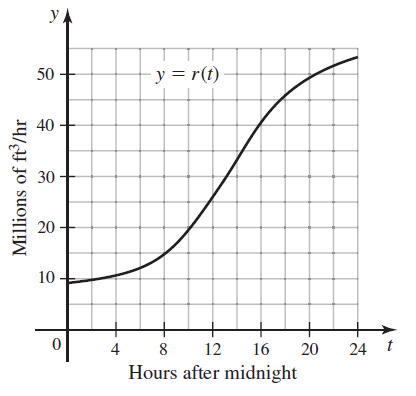
The following figure shows the discharge rate r(t) of the Snoqualmie River near Carnation, Washington, starting on a February day when the air temperature was rising. The variable t is the number of hours after midnight, r(t) is given in millions of cubic feet per hour, and ∫(0 to 24) r(t) dt equals the total amount of water that flows by the town of Carnation over a 24-hour period. Estimate ∫(0 to 24) r(t) dt using the Trapezoidal Rule and Simpson's Rule with the following values of n.


gra
n = 6

Verified step by step guidance
1
Step 1: Understand the problem. We are tasked with estimating the integral ∫(0 to 24) r(t) dt, which represents the total amount of water that flows by the town over a 24-hour period. We will use the Trapezoidal Rule and Simpson's Rule with n = 6 subdivisions.
Step 2: Divide the interval [0, 24] into n = 6 equal subintervals. The width of each subinterval, denoted as h, is calculated as h = (24 - 0) / 6 = 4 hours.
Step 3: Identify the values of r(t) at the endpoints and intermediate points of the subintervals. From the graph, approximate r(t) at t = 0, 4, 8, 12, 16, 20, and 24. These values will be used in both the Trapezoidal Rule and Simpson's Rule.
Step 4: Apply the Trapezoidal Rule formula: ∫(a to b) f(x) dx ≈ (h/2) * [f(x₀) + 2f(x₁) + 2f(x₂) + ... + 2f(xₙ₋₁) + f(xₙ)], where x₀, x₁, ..., xₙ are the points in the interval. Substitute the values of r(t) and h into this formula.
Step 5: Apply Simpson's Rule formula: ∫(a to b) f(x) dx ≈ (h/3) * [f(x₀) + 4f(x₁) + 2f(x₂) + 4f(x₃) + ... + 4f(xₙ₋₁) + f(xₙ)], where x₀, x₁, ..., xₙ are the points in the interval. Substitute the values of r(t) and h into this formula.

Verified video answer for a similar problem:

This video solution was recommended by our tutors as helpful for the problem above.
Video duration:
4m
Was this helpful?

Key Concepts

Here are the essential concepts you must grasp in order to answer the question correctly.

Definite Integral

A definite integral represents the accumulation of quantities, such as area under a curve, over a specified interval. In this context, ∫(0 to 24) r(t) dt calculates the total volume of water that flows past a point over a 24-hour period, where r(t) is the discharge rate of the river. Understanding definite integrals is crucial for estimating total quantities from rates.
Recommended video:
05:43
Definition of the Definite Integral

Trapezoidal Rule

The Trapezoidal Rule is a numerical method used to approximate the value of a definite integral. It works by dividing the area under the curve into trapezoids rather than rectangles, providing a better approximation of the area. This method is particularly useful when the function is not easily integrable or when only discrete data points are available, as in the case of river flow rates.
Recommended video:

Simpson's Rule

Simpson's Rule is another numerical technique for estimating the value of a definite integral, which uses parabolic segments to approximate the area under a curve. It is generally more accurate than the Trapezoidal Rule, especially for functions that are smooth and continuous. This method requires an even number of intervals and is beneficial for estimating the total water flow when given discrete data points.
Recommended video: