Ch. 8 - Integration Techniques
Briggs - Calculus: Early Transcendentals 3rd Edition
Briggs3rd EditionCalculus: Early TranscendentalsISBN: 9780136847243Not the one you use?Change textbook
Chapter 8, Problem 8.4.78b

Computing areas On the interval [0,2], the graphs of f(x)=x²/3 and g(x)=x²(9−x²)^(-1/2) have similar shapes.
b. Find the area of the region bounded by the graph of g and the x-axis on the interval [0,2].

Verified step by step guidance
1
Identify the function and the interval for which you need to find the area. Here, the function is \(g(x) = \frac{x^{2}}{\sqrt{9 - x^{2}}}\) and the interval is \([0, 2]\).
Recall that the area under the curve of a function \(g(x)\) from \(a\) to \(b\) is given by the definite integral \(\int_{a}^{b} g(x) \, dx\). So, set up the integral for the area as \(\int_{0}^{2} \frac{x^{2}}{\sqrt{9 - x^{2}}} \, dx\).
Consider a substitution to simplify the integral. Since the denominator involves \(\sqrt{9 - x^{2}}\), a trigonometric substitution such as \(x = 3 \sin \theta\) is appropriate because it will simplify the square root expression.
Perform the substitution: express \(x^{2}\), \(dx\), and \(\sqrt{9 - x^{2}}\) in terms of \(\theta\). For example, \(x = 3 \sin \theta\) implies \(dx = 3 \cos \theta \, d\theta\) and \(\sqrt{9 - x^{2}} = 3 \cos \theta\). Also, update the limits of integration accordingly by substituting \(x=0\) and \(x=2\) into \(x=3 \sin \theta\) to find the new \(\theta\) limits.
Rewrite the integral in terms of \(\theta\), simplify the integrand, and then integrate with respect to \(\theta\). After integrating, substitute back to \(x\) if necessary to express the area in terms of the original variable.

Verified video answer for a similar problem:

This video solution was recommended by our tutors as helpful for the problem above.
Video duration:
12m
Was this helpful?

Key Concepts

Here are the essential concepts you must grasp in order to answer the question correctly.

Definite Integral for Area Calculation

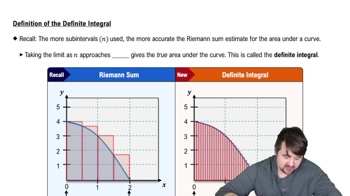
The definite integral of a function over an interval [a, b] represents the net area between the graph of the function and the x-axis. When the function is non-negative on the interval, the integral gives the exact area under the curve. This concept is essential for finding the area bounded by g(x) and the x-axis on [0, 2].
Recommended video:
05:43
Definition of the Definite Integral

Integrating Functions with Radical Expressions

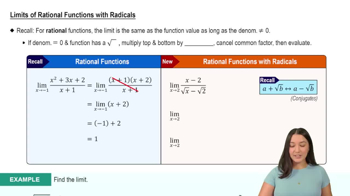
Functions involving radicals, such as g(x) = x² / √(9 - x²), often require substitution methods for integration. Recognizing the form and applying appropriate substitutions, like trigonometric substitution, simplifies the integral and makes it solvable. This technique is crucial for handling the integral of g(x).
Recommended video:
06:13
Limits of Rational Functions with Radicals

Domain and Interval Considerations

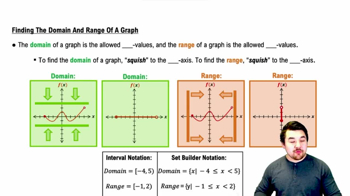
Understanding the domain of the function and the interval of integration ensures the integral is properly set up. Since g(x) involves a square root in the denominator, the expression under the root must be positive, restricting the domain. Confirming the function is defined and continuous on [0, 2] is necessary before integrating.
Recommended video:
5:10
Finding the Domain and Range of a Graph