Ch. 8 - Integration Techniques
Briggs - Calculus: Early Transcendentals 3rd Edition
Briggs3rd EditionCalculus: Early TranscendentalsISBN: 9780136847243Not the one you use?Change textbook
Chapter 8, Problem 8.4.86

Clever substitution Evaluate ∫ dx/(1 + sin x + cos x) using the substitution x=2 tan⁻¹ θ. The identities sin x = 2 sin(x/2) cos(x/2) and cos x =cos²(x/2) − sin²(x/2) are helpful.

Verified step by step guidance
1
Start by applying the substitution given: let \(x = 2 \tan^{-1} \theta\). This means you will express \(\sin x\), \(\cos x\), and \(dx\) in terms of \(\theta\).
Use the half-angle identities to rewrite \(\sin x\) and \(\cos x\) in terms of \(\sin(x/2)\) and \(\cos(x/2)\). Given \(x = 2 \tan^{-1} \theta\), note that \(x/2 = \tan^{-1} \theta\), so \(\sin(x/2) = \frac{\theta}{\sqrt{1 + \theta^2}}\) and \(\cos(x/2) = \frac{1}{\sqrt{1 + \theta^2}}\).
Substitute these into the identities: \(\sin x = 2 \sin(x/2) \cos(x/2)\) and \(\cos x = \cos^2(x/2) - \sin^2(x/2)\), and simplify the expressions in terms of \(\theta\).
Next, find \(dx\) in terms of \(d\theta\) by differentiating \(x = 2 \tan^{-1} \theta\). Recall that \(\frac{d}{d\theta} \tan^{-1} \theta = \frac{1}{1 + \theta^2}\), so \(dx = 2 \cdot \frac{1}{1 + \theta^2} d\theta\).
Rewrite the integral \(\int \frac{dx}{1 + \sin x + \cos x}\) entirely in terms of \(\theta\), simplify the integrand, and then integrate with respect to \(\theta\).

Verified video answer for a similar problem:

This video solution was recommended by our tutors as helpful for the problem above.
Video duration:
4m
Was this helpful?

Key Concepts

Here are the essential concepts you must grasp in order to answer the question correctly.

Trigonometric Substitution

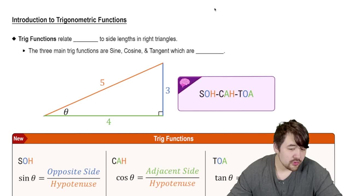
Trigonometric substitution involves replacing the variable with a trigonometric expression to simplify integrals. In this problem, substituting x = 2 tan⁻¹(θ) transforms the integral into a rational function of θ, making it easier to integrate by leveraging known identities and algebraic manipulation.
Recommended video:
6:04
Introduction to Trigonometric Functions

Half-Angle Identities

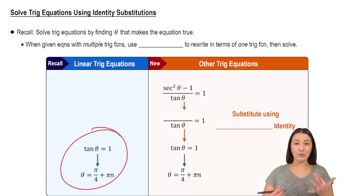
Half-angle identities express sine and cosine of an angle in terms of half that angle, such as sin x = 2 sin(x/2) cos(x/2) and cos x = cos²(x/2) − sin²(x/2). These identities help rewrite the integrand into a form suitable for substitution and simplification.
Recommended video:
4:42
Solve Trig Equations Using Identity Substitutions

Integration of Rational Functions

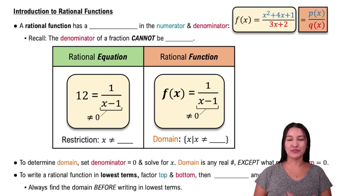
After substitution, the integral often reduces to a rational function in terms of θ. Understanding how to integrate rational functions, including partial fraction decomposition or direct integration techniques, is essential to solve the integral efficiently.
Recommended video:
6:04
Intro to Rational Functions