Ch. 8 - Integration Techniques
Briggs - Calculus: Early Transcendentals 3rd Edition
Briggs3rd EditionCalculus: Early TranscendentalsISBN: 9780136847243Not the one you use?Change textbook
Chapter 8, Problem 8.9.78

77–86. Comparison Test Determine whether the following integrals converge or diverge.
78. ∫(from 0 to ∞) dx / (eˣ + x + 1)

Verified step by step guidance
1
First, identify the behavior of the integrand \( \frac{1}{e^{x} + x + 1} \) as \( x \to \infty \) and as \( x \to 0 \) to understand the nature of the integral \( \int_0^{\infty} \frac{dx}{e^{x} + x + 1} \).
For large \( x \), note that \( e^{x} \) grows much faster than \( x + 1 \), so the integrand behaves approximately like \( \frac{1}{e^{x}} \). This suggests comparing it to the integral \( \int_0^{\infty} e^{-x} \, dx \), which is a convergent integral.
For \( x \) near 0, observe that \( e^{x} + x + 1 \) is continuous and positive, so the integrand is finite and well-behaved near 0, meaning there is no issue with convergence at the lower limit.
Apply the Comparison Test by finding a function \( g(x) \) such that \( 0 \leq \frac{1}{e^{x} + x + 1} \leq g(x) \) for all \( x \geq 0 \), and \( \int_0^{\infty} g(x) \, dx \) is known to converge. For example, use \( g(x) = e^{-x} \) since \( e^{x} + x + 1 > e^{x} \) implies \( \frac{1}{e^{x} + x + 1} < e^{-x} \).
Since \( \int_0^{\infty} e^{-x} \, dx \) converges, by the Comparison Test, the original integral \( \int_0^{\infty} \frac{dx}{e^{x} + x + 1} \) also converges.

Verified video answer for a similar problem:

This video solution was recommended by our tutors as helpful for the problem above.
Video duration:
5m
Was this helpful?

Key Concepts

Here are the essential concepts you must grasp in order to answer the question correctly.

Improper Integrals

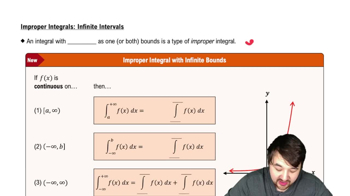
Improper integrals involve integration over an infinite interval or integrands with infinite discontinuities. To evaluate convergence, one must consider the limit of the integral as the bound approaches infinity or the point of discontinuity.
Recommended video:
11:11
Improper Integrals: Infinite Intervals

Comparison Test for Improper Integrals

The Comparison Test determines convergence by comparing the given integral to a second integral with a known behavior. If the integrand is smaller than a convergent integral's integrand, it converges; if larger than a divergent integral's integrand, it diverges.
Recommended video:
11:11
Improper Integrals: Infinite Intervals

Behavior of Exponential Functions at Infinity

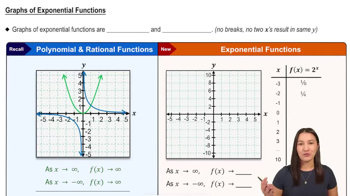
Exponential functions like eˣ grow faster than any polynomial or linear function as x approaches infinity. Understanding this growth helps in comparing integrands and determining whether the integral converges or diverges.
Recommended video:
5:46
Graphs of Exponential Functions