3. Explain geometrically how the Trapezoid Rule is used to approximate a definite integral.

Ch. 8 - Integration Techniques
Briggs3rd EditionCalculus: Early TranscendentalsISBN: 9780136847243Not the one you use?Change textbook
Chapter 8, Problem 8.5.17
17-22. Give the partial fraction decomposition for the following expressions.
17. (5x - 7) / (x² - 3x + 2)
Verified step by step guidance1
Start by factoring the denominator of the given rational expression. The denominator is \(x^{2} - 3x + 2\). Find two numbers that multiply to \(2\) and add to \(-3\).
Rewrite the denominator as a product of its factors: \(x^{2} - 3x + 2 = (x - 1)(x - 2)\).
Set up the partial fraction decomposition form for the expression \(\frac{5x - 7}{(x - 1)(x - 2)}\) as \(\frac{A}{x - 1} + \frac{B}{x - 2}\), where \(A\) and \(B\) are constants to be determined.
Multiply both sides of the equation by the denominator \((x - 1)(x - 2)\) to clear the fractions, resulting in \(5x - 7 = A(x - 2) + B(x - 1)\).
Expand the right side and collect like terms, then equate the coefficients of corresponding powers of \(x\) on both sides to form a system of equations. Solve this system to find the values of \(A\) and \(B\).

Verified video answer for a similar problem:
This video solution was recommended by our tutors as helpful for the problem above.
Video duration:
5mWas this helpful?
Key Concepts
Here are the essential concepts you must grasp in order to answer the question correctly.
Partial Fraction Decomposition
Partial fraction decomposition is a technique used to express a rational function as a sum of simpler fractions with denominators that are factors of the original denominator. This method simplifies integration and other operations by breaking down complex fractions into manageable parts.
Recommended video:
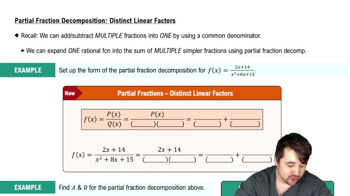
Partial Fraction Decomposition: Distinct Linear Factors
Factoring Quadratic Expressions
Factoring quadratic expressions involves rewriting a quadratic polynomial as a product of two binomials. For example, x² - 3x + 2 factors into (x - 1)(x - 2). Factoring is essential in partial fraction decomposition to identify the denominators of the simpler fractions.
Recommended video:
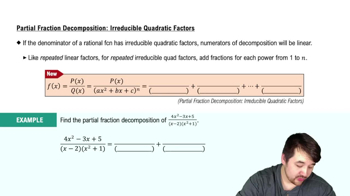
Partial Fraction Decomposition: Irreducible Quadratic Factors
Setting Up and Solving Systems of Equations
After expressing the rational function as a sum of partial fractions, coefficients are determined by equating numerators and solving the resulting system of linear equations. This step ensures the decomposition accurately represents the original expression.
Recommended video:
Solving Logarithmic Equations
Related Practice
Textbook Question
Textbook Question
7–40. Table look-up integrals Use a table of integrals to evaluate the following indefinite integrals. Some of the integrals require preliminary work, such as completing the square or changing variables, before they can be found in a table.
15. ∫ x / √(4x + 1) dx
Textbook Question
7. How would you evaluate ∫ tan¹⁰x sec²x dx?
Textbook Question
7–84. Evaluate the following integrals.
16. ∫ [1 / (x⁴ – 1)] dx
1
views
Textbook Question
95–98. {Use of Tech} Numerical methods Use numerical methods or a calculator to approximate the following integrals as closely as possible. The exact value of each integral is given.
98. ∫(from 0 to 1) (ln x)/(1+x) dx = -π²/12
Textbook Question
77–86. Comparison Test Determine whether the following integrals converge or diverge.
78. ∫(from 0 to ∞) dx / (eˣ + x + 1)
1
views