Ch. 8 - Integration Techniques
Briggs - Calculus: Early Transcendentals 3rd Edition
Briggs3rd EditionCalculus: Early TranscendentalsISBN: 9780136847243Not the one you use?Change textbook
Chapter 8, Problem 8.1.74

74. Volume of a Solid
Consider the region R bounded by:
The graph of f(x) = 1/(x + 2)
The x-axis on the interval [0,3].
Find the volume of the solid formed when R is revolved about the y-axis.

Verified step by step guidance
1
Step 1: Recognize that the problem involves finding the volume of a solid of revolution. Since the region R is revolved about the y-axis, we will use the method of cylindrical shells.
Step 2: Recall the formula for the volume of a solid using the method of cylindrical shells: V = 2πab x f(x) dx, where x is the radius of the shell, f(x) is the height of the shell, and [a, b] is the interval of integration.
Step 3: Substitute the given function f(x) = 1/(x + 2) and the interval [0, 3] into the formula. The volume becomes: V = 2π03 x ∕ (x + 2) dx.
Step 4: Simplify the integrand x ∕ (x + 2). Perform polynomial long division or rewrite the fraction to make it easier to integrate. This step will involve algebraic manipulation.
Step 5: Integrate the simplified expression with respect to x over the interval [0, 3]. After finding the antiderivative, evaluate it at the bounds 3 and 0, and multiply the result by 2π to find the volume.

Verified video answer for a similar problem:

This video solution was recommended by our tutors as helpful for the problem above.
Video duration:
4m
Was this helpful?

Key Concepts

Here are the essential concepts you must grasp in order to answer the question correctly.

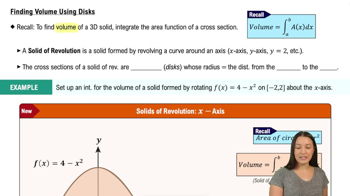
Volume of Revolution

The volume of revolution refers to the volume of a solid formed by rotating a two-dimensional shape around an axis. In this case, the region R is rotated about the y-axis, which requires the use of integration techniques to calculate the volume. The method of cylindrical shells or the disk/washer method can be applied, depending on the axis of rotation and the function involved.
Recommended video:
04:48
Finding Volume Using Disks

Integration

Integration is a fundamental concept in calculus that involves finding the accumulated area under a curve. In the context of finding volumes, integration allows us to sum up infinitesimally small cylindrical slices of the solid formed by the revolution. The definite integral will be evaluated over the specified interval to determine the total volume of the solid.
Recommended video:
06:18
Integration by Parts for Definite Integrals

Function Behavior

Understanding the behavior of the function f(x) = 1/(x + 2) is crucial for this problem. This function is continuous and positive over the interval [0, 3], which means the region R is well-defined for the volume calculation. Analyzing the function's properties, such as its limits and shape, helps in visualizing the solid formed and ensures accurate integration.
Recommended video:
5:46
Graphs of Exponential Functions